
by Dr. William Lovis
The onset and continuing impacts of global climate change has had a marked impact on the discovery of archaeological sites worldwide, including in Michigan. Professor Emeritus Dr. William Lovis explores this issue through a discussion of the discovery of the mid-19th century Saints’ Rest dormitory on the MSU Campus, recently published in The Michigan Archaeologist in an article titled “Extreme Regional Drought and the Rediscovery of The Agricultural College of the State of Michigan’s First Men’s Dormitory, Saints’ Rest”. Saints’ Rest dormitory, the first men’s dormitory at MSU, originally stood just east of the current MSU Museum. The building burned in an early morning conflagration during Christmas break on December 9, 1876. The NE corner of the dormitory was and still is marked by a concrete marker. It was thought that the remains of the dormitory had been demolished and that nothing remained.
During a late 1980s drought episode, however, Dr. Lovis noticed that the parched north campus lawn displayed well saturated green grass in right angle lines emanating from the concrete NE corner marker. Subsequent exploration by Lovis and MSU historical archaeologist Dr. Kenneth Lewis verified that the building foundation was still present below the green grass, and that remains of the dormitory were present and could be recovered archaeologically. Ultimately, the MSU Anthropology Department excavated Saints’ Rest dormitory as a Sesquicentennial Field School Project. While this story does not demonstrate that global climate change is desirable, it does demonstrate that its consequences can at times be unexpected, interesting and even beneficial! Please contact Dr. Lovis for article access at lovis@msu.edu.

(Michigan State University Archives and Historical Collections, A002337, reproduced with permission)
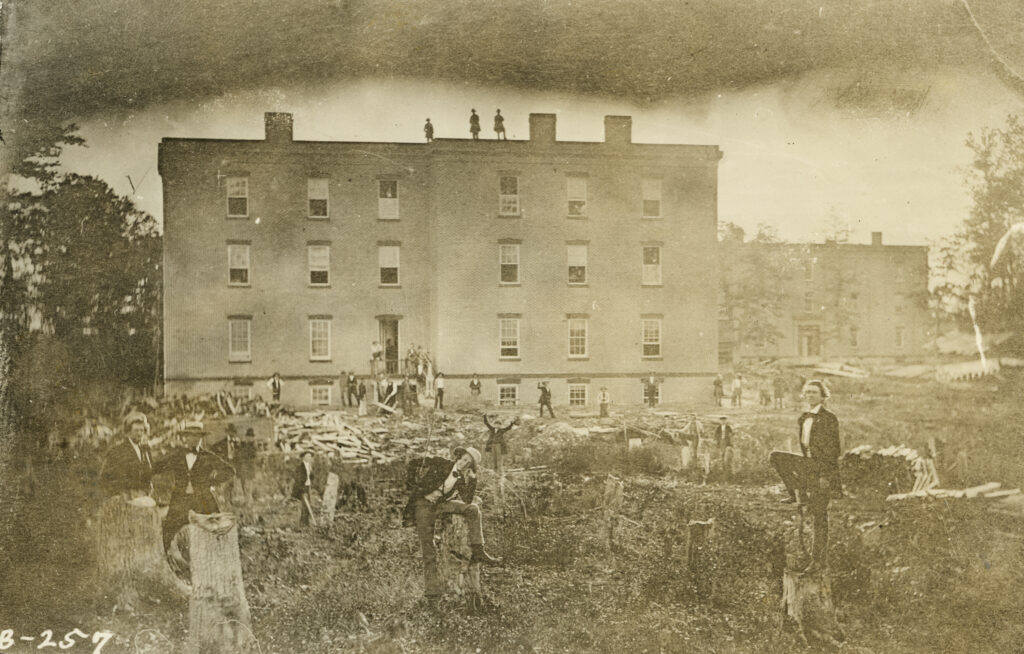
(Michigan State University Archives and Historical Collections, A002337, reproduced with permission)