
This semester, Dr. Madeline Mackie challenged students to examine the pseudoarchaeological claims made about the past in ANP 364: Fake Archaeology. Students explored topics from ancient aliens and Atlantis to mysterious megalithics and pyramids. While dissecting archaeological myths, frauds, and hoaxes, Mackie has guided students in learning how to identify false claims and understand why these ideas gain traction in popular media. Additionally, this course emphasizes the accurate methods used to reconstruct the past.

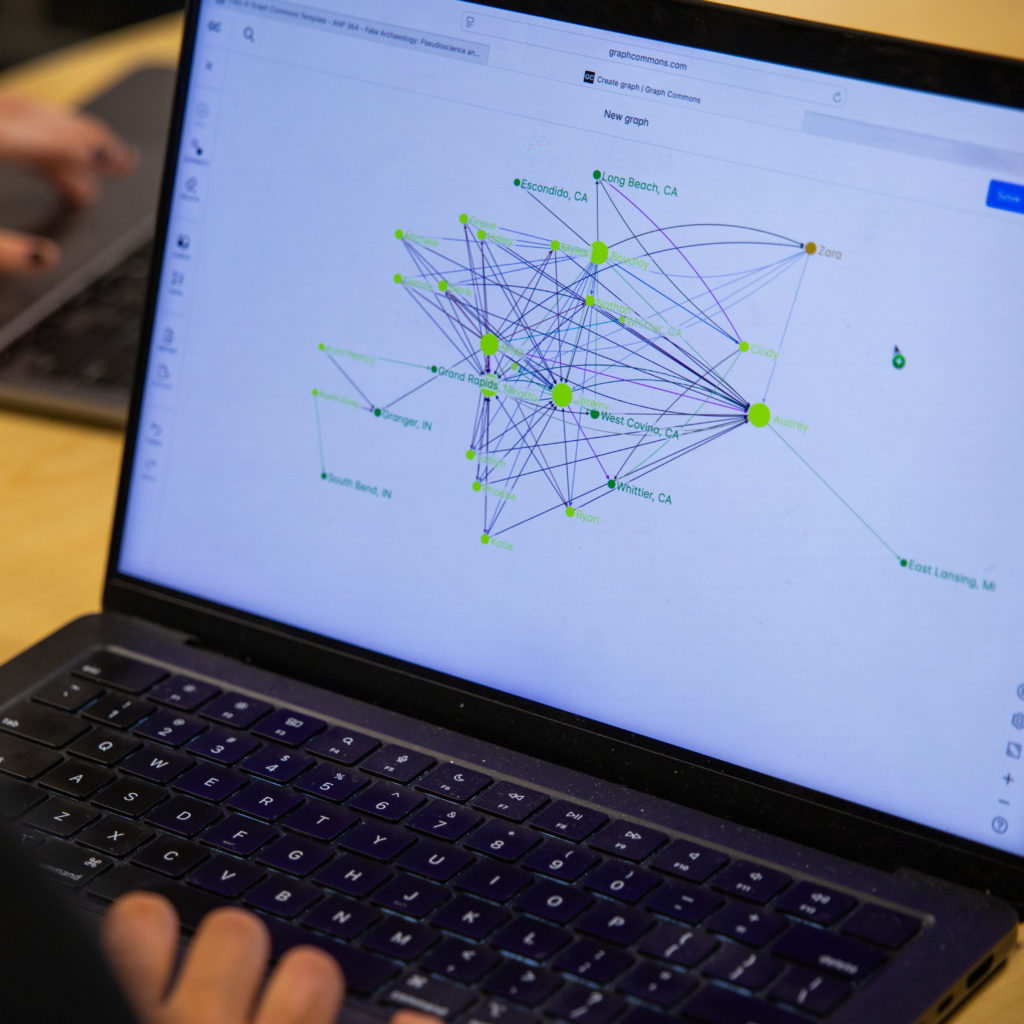
During this class session, students worked in the Lab for the Education and Advancement of Digital Research (LEADR) on their projects which analyze how social media communicates real and pseudoarchaeological claims. While in LEADR, Bryttany Grimes, a Ph.D student in MSU’s Department of History, provided students with instruction on the technical and digital skills needed to create network graphs mapping hashtags from various archaeological posts.

“The goal of the project is for students to critically think about how we reconstruct past human lives, what are good sources of archaeological information, potential biases, and how to evaluate information found in public spaces like social media,” Mackie said.


Read more about Mackie’s teaching philosophy and how this course prepares students for their future.
Why do you feel it is important to provide students with hands-on experiences?
The most impactful experiences I had as an undergraduate were hands-on research projects. As a professor, I find LEADR to be incredibly impactful for student learning because it allows me to incorporate digital tools into the classroom even if they lie outside my technical expertise. LEADR helps train students in the nuts and bolts of how the digital methods work, while I can focus on the quality of the content students are producing and referencing.
How do you see this class preparing students for their future careers or professional goals?
The class builds transferable skills valuable for students of any career path. Particularly, the course encourages students to think critically about identifying credible information and developing media literacy by dissecting how information spreads. We also spend time talking about ethics in communication and the consequences of the popularization of inaccurate claims.
What’s the biggest takeaway you hope students leave this class with?
I hope students leave with tools to evaluate evidence to determine the legitimacy of a claim. In today’s digital world, where we are often overwhelmed by content, it’s more important than ever to be able to critically evaluate information. I also hope they leave with an appreciation for the amazing history, ingenuity, and capabilities of humans around the world. Many of the claims we learn about in class ignore or decenter human ingenuity resulting in devaluation of human history and can intentionally or unintentionally cause real harm, particularly to descendant populations.
What has been your favorite part of teaching ANP 364?
I have been joking that this class is like one giant rabbit hole. Many of the pseudoarchaeological claims we go over in class have deep historical routes with their own interesting, and occasionally infuriating, connections. Likewise, the class offers the opportunity to cover some of the most fascinating materials from the archaeological record like Egyptian pyramids, Göbekli Teppe, Stonehenge, Indigenous earthworks, and more.
By Louise Henderson