• MSU archaeologist and team publish key insights on natural and human processes in the Andes Mountains

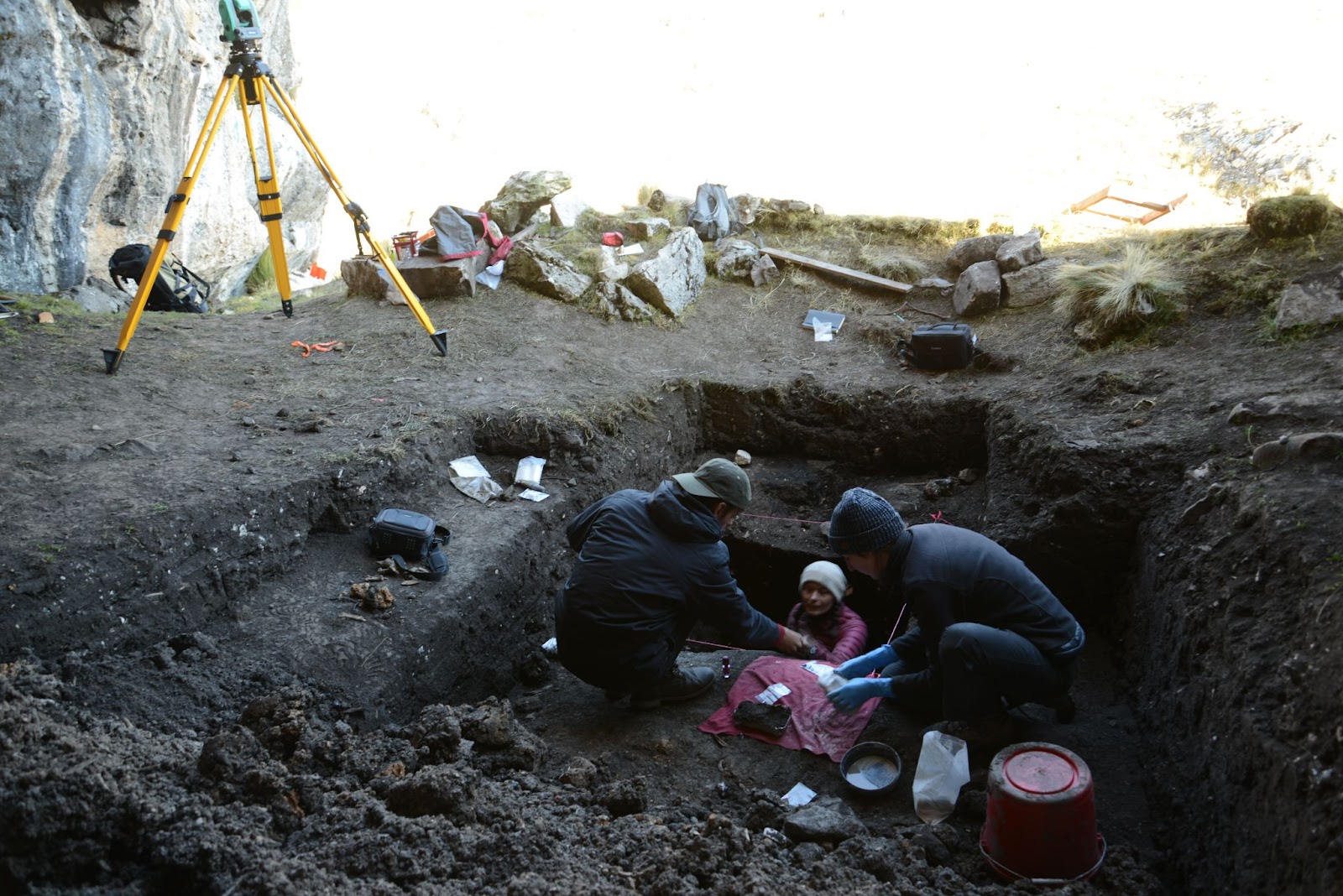
     Doctoral student Sarah Meinekat working with other graduate students at the Cuncaicha rock shelter archaeological site.

    The intersection of archaeology and geology tells the story of human connection and interaction with the earth. What if we could go back in time to understand how people lived in the highest altitudes in the Americas across time? The archaeological and geological record has left behind clues for MSU Department of Anthropology Assistant Professor Kurt Rademaker and his team. 

    “People at the end of the last Ice Age managed to live in the high Andes, an extremely challenging environment where modern nighttime temperatures drop to -10 C (15 degrees F) and where there is only 60% of the oxygen pressure relative to sea level,” Rademaker said. 

    “This highlights how incredibly adaptive our species is. This archaeological site records evidence of wet and dry climate phases over the past 12,000 years, and it shows that people shifted their settlement strategies according to those changes. Archaeology can be a powerful tool to learn about the relationship between people and their environments.” 

    Most recently, Rademaker and his team have published a new paper in the journal Geoarchaeology called “A site formation model for Cuncaicha rock shelter: Depositional and post-depositional processes at the high-altitude keysite in the Peruvian Andes” Rademaker and co-author Christopher Miller advise Sarah Meinekat, who is a doctoral student at the University of Tübingen and the publication’s lead author. The paper presents a detailed sequence of site formation processes and environmental change recorded in the highest-elevation Pleistocene archaeological site in the Americas. At 4480 m (14,700 feet) above sea level, the Cuncaicha rockshelter is the highest-elevation Pleistocene (Ice Age) archaeological site in the Americas

    “The site contains a well-preserved record of episodic human occupations over the past 12,300 years,” Rademaker said. “Our team applied cutting-edge techniques to study the natural and human processes that formed the site’s sediment sequence. These methods have been applied to very early few sites in South America, but doing so is important for making reliable interpretations about past human behavior.”

    The team learned two key insights during this phase of their research.

    “One, we gained insights on the intensity of occupation through time, which tells us how people were using the site,” he explained. “The sediments show that people generated large quantities of ash from campfires and dense accumulations of artifacts and plant and animal remains, consistent with using the site as a residential campsite. Two, the timing of site occupations and abandonments is not accidental. The high resolution of our radiocarbon dating and stratigraphy links the site occupations with wetter climate phases and abandonments with arid phases.” 

    Rademaker has enjoyed being an advisor and mentor to Meinekat, doctoral candidate at the University of Tübingen.  

    “Sarah has done outstanding work on one of South America’s most important early archaeological sites! She is currently conducting similar investigations on other early sites in the Andes and Pacific coast of South America.” 

    To read their publication, visit http://doi.org/10.1002/gea.21889.

  • Early Chiquihuite Cave “artifacts” are likely natural in origin

    The timing of humans’ first arrival in the Americas south of glacial ice remains a topic of heated debate in archaeological circles. In the summer of 2020, a team working in Mexico claimed discovery of evidence for human occupation of a remote highland cave beginning over 30,000 years ago.  Because this announcement was made in the journal Nature, it was disseminated broadly and thus rapidly became accepted doctrine in the public mind before it had been vetted by the scientific community.  Today in the journal Paleoamerica, which focuses on first Americans issues, a group of 20 researchers from the US and Mexico, including MSU Anthropology Assistant Professor Kurt Rademaker, challenge the Chiquihuite claim on the basis of their review of the evidence. 

    They found that the Chiquihuite authors failed to consider the alternative hypothesis that the objects were the result of natural processes.  Chatters et al. examined both hypotheses (human vs. natural agency) and determined that the Chiquihuite assemblage is probably composed of limestone broken through natural processes, or “geofacts.” Relevant data included fracture mechanics, where the stone pieces more closely match geofact expectations and the geochemical analyses which failed to distinguish purported artifacts from naturally occurring rocks. Thus, Chiquihuite Cave does not represent very early human occupations in the Americas, and does not support human arrival before the Last Glacial Maximum.

    Read the two papers here:

    Critique of Ardelean et al.

    https://www.tandfonline.com/doi/full/10.1080/20555563.2021.1940441

    Critique of Valdivia and Higham

    https://www.tandfonline.com/doi/full/10.1080/20555563.2021.1978721

  • MSU Forensic Anthropology Lab participates in Operation UNITED

    This September, the MSU Forensic Anthropology Laboratory (MSUFAL) participated in Operation UNITED in collaboration with the FBI’s Evidence Response Team, the Detroit Police Department (DPD), and several other local universities and law enforcement agencies. Operation UNITED is an acronym which stands for “Unknown Names Identified Through Exhumation and DNA.”

    Operation UNITED began as a grassroots effort between DPD Sgt. Shannon Jones and FBI Special Agent Leslie Larsen to solve as many cold case homicides in Detroit as possible. By exhuming the remains of unidentified homicide victims and comparing their DNA with family reference samples, Operation UNITED seeks to make identifications and jump start cold case investigations. This is the third season of the project and participants have successfully exhumed the remains of over 100 unidentified homicide victims, several of which have ultimately led to positive identifications.

    Dr. Carolyn Isaac, Assistant Professor in the Department of Anthropology and MSUFAL Laboratory Director, as well as graduate students in the Department of Anthropology Clara Devota, Rhian Dunn, Micayla Spiros, and Alex Goots attended the three-day excavation. Each graduate student joined an interdisciplinary team and worked to locate and excavate remains based on cemetery records and autopsy details. Dr. Isaac rotated between the teams, providing her expertise in forensic anthropology and confirming whether or not the remains matched the demographic details of the person in question.

    According to Special Agent Leslie Larsen, “Forensic anthropologists on scene are the instrumental piece that we need to make sure we are exhuming the correct bodies from the ground. They review the case files and autopsy reports then match those findings with the human remains uncovered by our dig site teams. Without on-site forensic anthropologists working with us, we would not be able to do these body recoveries.”

    Over the course of the three day excavation, Operation UNITED was able to recover human remains from 21 individuals, bringing the running grand total of DNA samples to 121 individuals for the whole project. In short, 121 individuals who have been missing, some for decades, finally have the opportunity to be identified and properly laid to rest, thanks to the tireless efforts of everyone involved in Operation UNITED.

  • PhD Student Juan Carlos Rico Noguera wins Whiteford Cultural Anthropology Field Work Scholarship

    The Department of Anthropology is pleased to announce that the inaugural Whiteford Cultural Anthropology Field Work Scholarship was awarded to PhD student Juan Carlos Rico Noguera. With the financial support of MSU Anthropology alumni Aaron and Jill Whiteford, the Whiteford Cultural Anthropology Field Work Scholarship has been established to support graduate students in sociocultural anthropology in their field work endeavors, with preference given to those students conducting research in Latin America.

    Rico Noguera’s research involves different ways of understanding the human experience, including the conceptual definition of the State, the role experts have in modern politics, and the way collective memory is produced by political agents. In particular, his research focuses on the Colombian armed conflict, which began in 1964. According to Rico Noguera, after almost 60 years of political violence, it is difficult to find a common understanding over questions such as: what are the causes of the Colombian political violence? Who is responsible for massive human rights violations, such as forced disappearing, targeted killings, massacres, forced displacement, torture, and kidnapping? Paintings in walls across the country, like the one pictured below, dispute pervasive narratives suggesting Colombia is a regular and stable democracy by reminding people of the prevalence of targeted killings that have become hallmarks of political violence.

    A mural in Colombia reads, “They are disappearing us.”

    Rico Noguera is interested in contributing to a better understanding of Latin American social processes and the Colombian politics associated with how its violent past is collectively evoked. Further, Rico Noguera intends to explore how communities with very different experiences and understandings of the Colombian past engage with transitional justice mechanisms. His research will involve institutions such as the Truth Commission and other organizations who have a legal obligation to clarify human rights violations and the causes of those violations.

    The funds from the Whiteford Cultural Anthropology Field Work Scholarship will enable Rico Noguera to cover research expenses for the first phase of his dissertation research in Colombia. This phase of research will explore how three different communities engage with the Colombian State and its duty to remember 50 years of armed conflict. The first phase of this ethnographic study will take place in the offices of the “Institutional Memory” group, belonging to the Colombian National Police.

    Rico Noguera would like to express his gratitude to Aaron and Jill Whiteford, as their generosity is enabling Rico Noguera to begin his dissertation field work in Colombia. Rico Noguera notes that the Whiteford scholarship has provided him with a vital asset in the scholarly world: a vote of confidence. He plans to use both the funds and confidence gained from the Whiteford scholarship to seek further funding and successfully complete his dissertation field work. Additionally, Rico Noguera expresses his appreciation for the guidance and support of his dissertation committee: Dr. Elizabeth Drexler (chair), Dr. Lucero Radonic, Dr. Mindy Morgan, and Dr. Edward Murphy.

  • Dr. Joe Hefner receives five-year NIH funding to develop graphical library for craniofacial anomalies

    The Department of Anthropology is pleased to announce that the National Institute of Dental & Craniofacial Research of the National Institutes of Health (NIH) has awarded Department of Anthropology Assistant Professor Joseph T. Hefner (Co-PI) and colleagues at the University of Kentucky (PI: Dr. Melissa Clarkson) a five year $1,447,281 grant to develop a standardized graphic library to assist clinicians and biomedical researchers in communicating anatomical concepts and patient-specific anatomy.

    The project—Developing standardized graphic libraries for anatomy: A focus on human craniofacial anatomy and phenotypes—began Summer of 2021. The purpose of the graphic library is to support rapid and anatomically-accurate communication in clinical practice, medical education, and clinical research. The graphics will depict craniofacial anatomy, variation in phenotypes, and anomalies of clinical importance (such as orofacial clefting) and serve as standardized visual representations for information systems and software applications. The research team will develop graphical representations of both adult and developmental anatomy. Their work will include developing prototypes for two web-based tools—one incorporating graphics into the Human Phenotype Ontology and the other documenting craniofacial phenotypes and malformations in clinical settings.

    As a biological anthropologist, Dr. Hefner brings both his knowledge of global human craniofacial variation and his understanding of biometric methods to this work. Dr. Hefner notes that his contribution to the project “will provide a more nuanced understanding of craniofacial anomalies to the clinician, based in part on a better understanding of human variation.”

    Project PI, Dr. Clarkson, explained, “I am very happy to have Dr. Hefner on this project. Our goal is to clarify the definitions and classifications used to describe craniofacial phenotypes and malformations. Many definitions are based on population-level data. For example, ‘wide mouth’ is defined as the distance between the corners of the mouth greater than two standard deviations above the mean. But what does that look like in a living individual? Drawing that phenotype will depend on population-level data, and that data should reflect different ages and populations. Dr. Hefner will help us to understand population-level differences in phenotypes and how to incorporate craniometric and macromorphoscopic datasets into our work.”

    Please join us in congratulating Dr. Hefner on this exciting, collaborative, and important new project!

    “The National Institutes of Health is the largest public funder of biomedical research in the world, investing nearly $43 billion in fiscal year 2021 to enhance life, and reduce illness and disability. NIH-funded research has led to breakthroughs and new treatments helping people live longer, healthier lives, and building the research foundation that drives discovery.” For more information, visit www.nih.gov.

  • Dr. Kurt Rademaker publishes in Science on the evolution of the hepatitis B virus

    Department of Anthropology Assistant Professor Kurt Rademaker recently coauthored a publication in the prestigious journal Science. The article is entitled “Ten millennia of hepatitis B virus evolution.” In this new study, researchers uncover the evolution of the hepatitis B virus since the Early Holocene by analyzing the largest dataset of ancient viral genomes produced to date.

    The hepatitis B virus (HBV) is a major health problem worldwide, causing close to one million deaths each year. Recent ancient DNA studies have shown that HBV has been infecting humans for millennia, but its past diversity and dispersal routes remain largely unknown. A new study conducted by a large team of researchers from all around the world provides major insights into the evolutionary history of HBV by examining the virus’ genomes from 137 ancient Eurasians and Native Americans dated to between ~10,500 and ~400 years ago. Their results highlight dissemination routes and shifts in viral diversity that mirror well-known human migrations and demographic events, as well as unexpected patterns and connections to the present.

    The oldest known HBV genome in the Americas was identified in an Andean burial dated to 9,000 years ago from Cuncaicha rockshelter in southern Peru. Dr. Rademaker discovered the Cuncaicha site in 2007 and has led investigations of the site since 2010. At 4480 m (14,700 feet) above sea level, Cuncaicha is the highest-elevation ice-age site in the Americas and one of the highest Pleistocene sites in the world.

    Cuncaicha contains a well-dated sequence of occupation deposits spanning from 12,300 years ago to present day. This material evidence indicates that men, women, and children lived here episodically for millennia. Beginning in the Early Holocene, about 9000 years ago, some plateau residents were buried in the rockshelter. Collaborative research between Rademaker’s MSU-based Paleo Andes working group and colleagues at the Max Planck Institute for the Science of Human History and University of Tübingen in Germany has revealed insights about early Andean diet, mobility, and adaptations to life at high elevation.

    As the oldest HBV case in the Americas, Cuncaicha’s 9,000 year-old genome helped the team determine that the most recent common ancestor of all HBV strains worldwide existed around the end of the Pleistocene. This common ancestor gave rise to one or several lineages that spread across Eurasia and eventually reached Africa and Oceania, and to another lineage that spread into the Americas with early settlers of the western hemisphere.

    Read the full article at: https://www.science.org/doi/10.1126/science.abi5658

    Abstract: “Hepatitis B virus (HBV) has been infecting humans for millennia and remains a global health problem, but its past diversity and dispersal routes are largely unknown. We generated HBV genomic data from 137 Eurasians and Native Americans dated between ~10,500 and ~400 years ago. We date the most recent common ancestor of all HBV lineages to between ~20,000 and 12,000 years ago, with the virus present in European and South American hunter-gatherers during the early Holocene. After the European Neolithic transition, Mesolithic HBV strains were replaced by a lineage likely disseminated by early farmers that prevailed throughout western Eurasia for ~4000 years, declining around the end of the 2nd millennium BCE. The only remnant of this prehistoric HBV diversity is the rare genotype G, which appears to have reemerged during the HIV pandemic.”

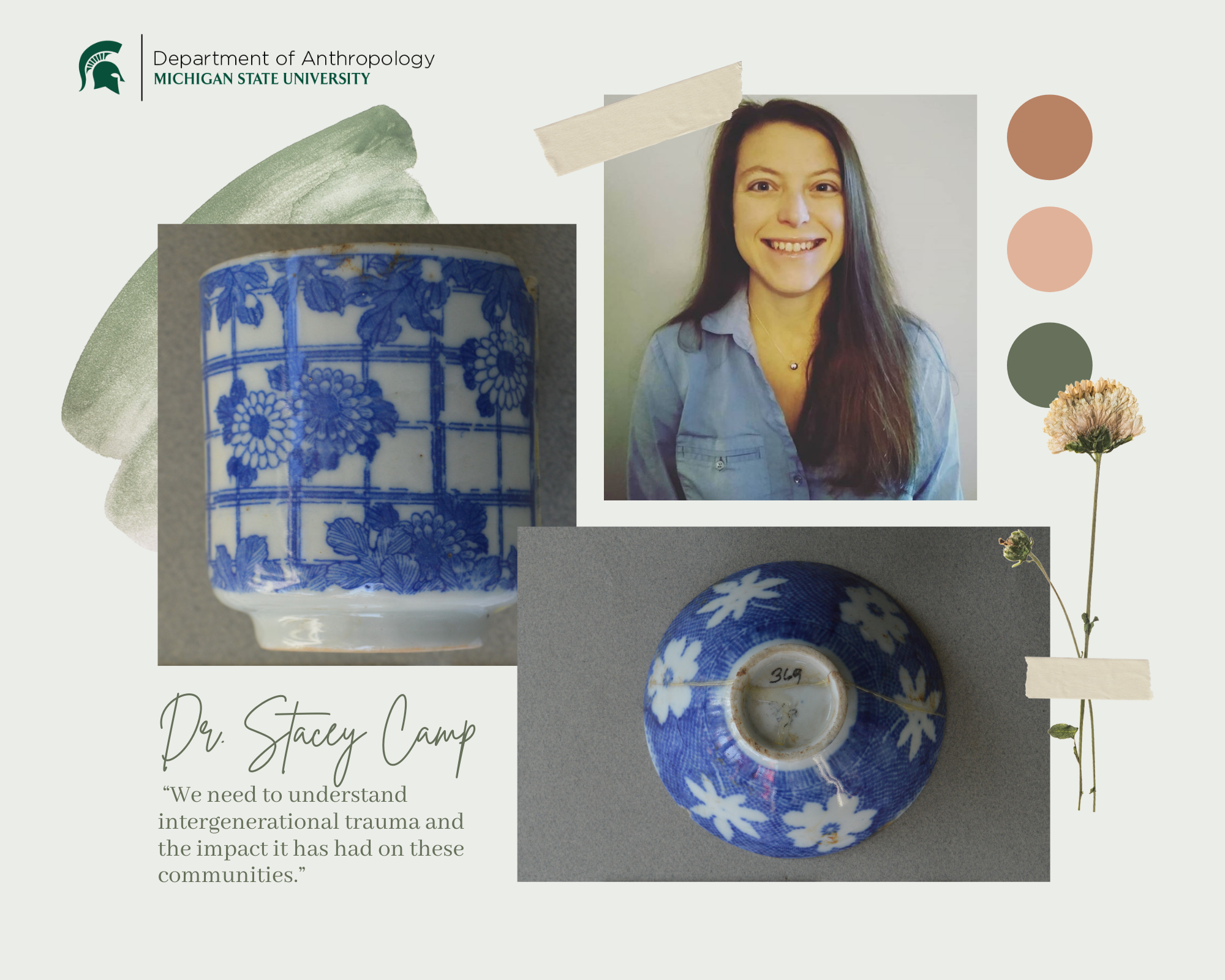
  • Dr. Stacey Camp featured in film on WWII Japanese-American internment experiences

    Dr. Stacey Camp featured in film on WWII Japanese-American internment experiences

    By Katie Nicpon

    A Buddhist temple, a church, a hotel, grocery stores, homes, a barbershop – Nihonmachi or “Japantown” in Santa Barbara, California, was thriving in the 1920s and 1930s. But that was before February 1942, when President Roosevelt issued Executive Order 9066 that allowed the United States government to incarcerate over 120,000 Japanese-Americans. 

    The new feature film, Sonzai: Japantown in Santa Barbara, tells the story of this community through oral histories, research and archaeological artifacts to examine life before and after the Japanese-American residents were forcibly removed from their community and their presence was erased. Stacey Camp, PhD, who is an archaeologist and associate professor in the MSU Department of Anthropology and the Campus Archaeology Program Director, participated on the research team highlighted in the film. 

    “My research is on Japanese-Americans incarcerated during WWII and how material practices changed after being incarcerated,” Camp said. “When I was hired at MSU in 2017, I used my start-up funds to look at a collection of materials from a Japanese-American community that was excavated during a dig for Spanish-colonial remains in downtown Santa Barbara.” 

    The collection was enormous and had a lot of potential with reports written by famous archaeologists of the 1960s and 1970s. But it was in need of being rehoused and rehabilitated, slowly degrading away in storage. Camp knew that it deserved a collaborative, deep-dive, so she reached out to Koji Lau-Ozawa, a historical archaeologist and Stanford doctoral candidate, about leading the research project to examine this material. 

    “He had family who were incarcerated in Japanese-American internment camps, and this was a part of his doctoral dissertation to understand what life was like prior to people being incarcerated,” Camp said. “Also, Koji knows the descendant community well, he speaks Japanese and he was able to talk to a number of descendant community members and collect their stories.” 

    While Lau-Ozawa studied the larger collection of data, Camp contributed to the project by studying two boxes of material pieces that did not have “provenance,” which means the pieces that did not have a precisely documented or clear location where it was archaeologically uncovered. 

    The film, directed by Barre Fong, covers this story about how this collection is coming to life. 

    “One of the stories that stuck with me is that a Nihonmachi descendant, her family came back to Santa Barbara and wanted to rent an apartment because they lost their business and their property, but no one would rent to them,” said Camp. “In the three years of the war, Japanese-Americans were intentionally erased from the landscape and they lost everything on the West Coast.” 

    The film was created for the second annual Tadaima! A Community Virtual Pilgrimage, a virtual event created to safely experience the Japanese American Memorial Pilgrimages that have been cancelled due to the COVID-19 pandemic. This year, Tadaima’s focus was identity, indigeneity, and intersectionality related to the WWII incarceration of Japanese Americans, and the virtual event invited the Japanese-American community and allies to participate. The film was shown live followed by a discussion with Fong and Lau-Ozawa that was moderated by Camp. 

    “I am proud of the film, and really grateful to have had the chance to moderate an interview with Barre and Koji during Tadaima,” Camp said. “To bring people in communities together around archaeological collections is why I am an anthropologist. This is the most fulfilling part of my career.” 

    The treatment of Japanese-Americans has far-reaching implications for today. 

    “This is an important American story that everyone needs to understand about how immigrants have been treated,” Camp said. “We need to understand intergenerational trauma and the impact it has had on these communities, and bring that understanding to the decisions we’re making about immigrants today.” 

    To watch the film and Camp’s moderated conversation with Lau-Ozawa and Fong, visit https://www.youtube.com/watch?v=BOofWgTz8SA.

  • MSU Department of Anthropology hosts the 2021 Midwest Archaeology Conference

    The Michigan State University Department of Anthropology is hosting the joint annual meeting of the Midwest Archaeological Conference and the Midwest Historical Archaeology Conference October 7–9, 2021, on MSU’s campus. Jodie O’Gorman, MSU associate professor and archaeologist, is leading the team responsible for organizing the conference. 

    “Our membership gets together to share the research we’ve been doing. It’s an important opportunity for us to see colleagues, meet new and prospective students, and debate and discuss issues that are important to all of us,” O’Gorman said. 

    The Midwest Archaeological Conference is the regional association for archaeologists and students working in the Mid-continent. It has been held annually for the last 64 years, except last year due to the novel coronavirus pandemic. The Department of Anthropology is looking forward to bringing over 150 people and 21 student volunteers together again with special precautions to allow for social distancing.

    “MSU has always been one of the most influential institutions in Midwest and Great Lakes archaeology,” O’Gorman said. “Many of our archaeology alumni still live and work in the Midwest and are members of MAC. They hold some of the most influential archaeology positions in national, state, and private organizations. We celebrate the opportunity to reconnect with them. We also see it as an opportunity to let others see how strong our program is.” 

    The meeting this year is a joint meeting with the Midwest Historical Archaeology Conference because O’Gorman and her colleagues decided to co-host this meeting to stress the importance of both kinds of archaeology at MSU. The co-organizers are Drs. Jessica Yann and Stacey Camp, Director of MSU’s Campus Archaeology Program. 

    “I hope people enjoy reconnecting with colleagues. Some of the papers reflect on archaeology in the time of COVID, and I think it’s important for us to share that and to support each other,” O’Gorman said. “I think people will also enjoy just getting back to a bit of normalcy in terms of hearing research papers.”

    Attendees will attend sessions, workshops and a Campus Archaeology tour of MSU.

    “One unique event is the MAC-sponsored symposium I co-organized with several former and current students,” O’Gorman said. “We’ve assembled 13 papers on ‘Midcontinental Cuisine: Recent Archaeological Explorations of Food and Cooking in the Heartland,’ about cuisine from ancient times to MSU’s early history. We’re also featuring MSU historical cuisine at the following reception in collaboration with MSU chefs.”

    Other events during the conference are a workshop on building an inclusive culture in the field, and two workshops (one for students and one for practicing archaeologists) on 3D Digitization, Preservation, and Access in Archaeology and Heritage. The 3D workshops will be presented by Dr. Ethan Watrall in the college’s Lab for the Education and Advancement in Digital Research (LEADR), an interdisciplinary venture of Anthropology, History, and Matrix.

    “The past cultures we study lived from the edge of the Plains into the forests of the Northeast, around the Great Lakes as well as smaller inland lakes, and along major and minor river valleys,” O’Gorman said. “Indigenous groups have been here since at least 15,000 years ago and their cultural heritage is especially rich and varied.”

    Hosting the conference has special meaning to O’Gorman.

    “I first became interested in MSU when I attended a MAC meeting here 22 years ago,” O’Gorman said. “That meeting led to my application for the position I hold now. As I think about retirement, I hope the younger generation of Midwest archaeologists attending this year will see what an exciting program we have.” 

    To learn more about the Midwest Archaeology Conference, visit https://www.midwestarchaeology.org/about.

  • Dr. Lucero Radonic, Dr. Rowenn Kalman, PhD student Cara Jacob, and E. Yvonne Lewis publish in Qualitative Research on short-term community-based participatory research

    Department of Anthropology Assistant Professors Lucero Radonic and Rowenn Kalman, PhD student Cara Jacob, and Co-Director of the Healthy Flint Research Coordinating Center Community Core (HFRCC) E. Yvonne Lewis recently published an article in Qualitative Research. The article is titled “It’s a sprint, not a marathon: a case for building short-term partnerships for community-based participatory research.” The article discusses the ways in which scholars can engage in community-based participatory research within the time constraints of an academic schedule.

    Read the full article at: https://doi.org/10.1177/14687941211029477

    Abstract: “Academic calendars and university timelines set an urgent pace for researchers, which can hinder the establishment of long-term community partnerships. Given community-based participatory research’s (CBPR) emphasis on community-led research, time constraints can inhibit academic researchers’ commitments to collaborative methodologies and participatory research. This article considers how CBPR can be adapted for shorter-term engagements while still producing mutually beneficial research. In doing so, we contribute to the existing corpus on rapid assessment methodologies, characterized for adopting methods traditionally practiced over a longer duration to shorter time frames. We review the successes and limitations of a CBPR project executed within the timespan of six months in Flint, Michigan. In the case discussed, photo-voice enabled the inclusion of diverse ways of knowing, horizontal partnerships, reciprocal learning, and an accessible dissemination format within a CBPR framework. In conclusion we assert that there is value in short-term CBPR, especially for emergent issues where there is a need for rapid, responsive methodologies. However, short-term CBPR is a sprint, rather than a marathon; although shorter in duration, it is more intensive. It requires significant methodological commitments, flexibility, and an intensified workload for those involved.”

  • Dr. Linda Hunt, Dr. Heather Howard, Dr. Elisabeth Arndt, and Hannah S. Bell publish in Bioethical Inquiry on the pharmaceutical industry’s involvement in diabetes treatment

    Department of Anthropology Professor Dr. Linda Hunt, Associate Professor Dr. Heather Howard, alum Dr. Elisabeth Arndt, and alum Hannah S. Bell recently published an article in Bioethical Inquiry. The article is titled “Are Corporations Re-Defining Illness and Health? The Diabetes Epidemic, Goal Numbers, and Blockbuster Drugs.” The article discusses the influence of the pharmaceutical industry in screening, diagnosis, and treatment guidelines for type 2 diabetes and raises concerns about the pervasive conflicts of interest in medical research.

    Read the full article at: https://doi.org/10.1007/s11673-021-10119-x

    Abstract: “While pharmaceutical industry involvement in producing, interpreting, and regulating medical knowledge and practice is widely accepted and believed to promote medical innovation, industry-favouring biases may result in prioritizing corporate profit above public health. Using diabetes as our example, we review successive changes over forty years in screening, diagnosis, and treatment guidelines for type 2 diabetes and prediabetes, which have dramatically expanded the population prescribed diabetes drugs, generating a billion-dollar market. We argue that these guideline recommendations have emerged under pervasive industry influence and persisted, despite weak evidence for their health benefits and indications of serious adverse effects associated with many of the drugs they recommend. We consider pharmaceutical industry conflicts of interest in some of the research and publications supporting these revisions, and in related standard-setting committees and oversight panels. We raise concern over the long-term impact of these multifaceted involvements. Rather than accept industry conflicts of interest as normal, needing only to be monitored and managed, we suggest challenging that normalcy, and ask: what are the real costs of tolerating such industry participation? We urge the development of a broader focus to fully understand and curtail the systemic nature of industry’s influence over medical knowledge and practice.”