• Regional Drought and Saints’ Rest Dormitory Discovery

    Regional Drought and Saints’ Rest Dormitory Discovery

    by Dr. William Lovis

    The onset and continuing impacts of global climate change has had a marked impact on the discovery of archaeological sites worldwide, including in Michigan.  Professor Emeritus Dr. William Lovis explores this issue through a discussion of the discovery of the mid-19th century Saints’ Rest dormitory on the MSU Campus, recently published in The Michigan Archaeologist in an article titled “Extreme Regional Drought and the Rediscovery of The Agricultural College of the State of Michigan’s First Men’s Dormitory, Saints’ Rest”.  Saints’ Rest dormitory, the first men’s dormitory at MSU, originally stood just east of the current MSU Museum.  The building burned in an early morning conflagration during Christmas break on December 9, 1876. The NE corner of the dormitory was and still is marked by a concrete marker.  It was thought that the remains of the dormitory had been demolished and that nothing remained.  

    During a late 1980s drought episode, however, Dr. Lovis noticed that the parched north campus lawn displayed well saturated green grass in right angle lines emanating from the concrete NE corner marker.  Subsequent exploration by Lovis and MSU historical archaeologist Dr. Kenneth Lewis verified that the building foundation was still present below the green grass, and that remains of the dormitory were present and could be recovered archaeologically.  Ultimately, the MSU Anthropology Department excavated Saints’ Rest dormitory as a Sesquicentennial Field School Project.  While this story does not demonstrate that global climate change is desirable, it does demonstrate that its consequences can at times be unexpected, interesting and even beneficial!  Please contact Dr. Lovis for article access at lovis@msu.edu.  

    Michigan Agricultural College first men’s dormitory, later given the name Saints’ Rest. 
    (Michigan State University Archives and Historical Collections, A002337, reproduced with permission)
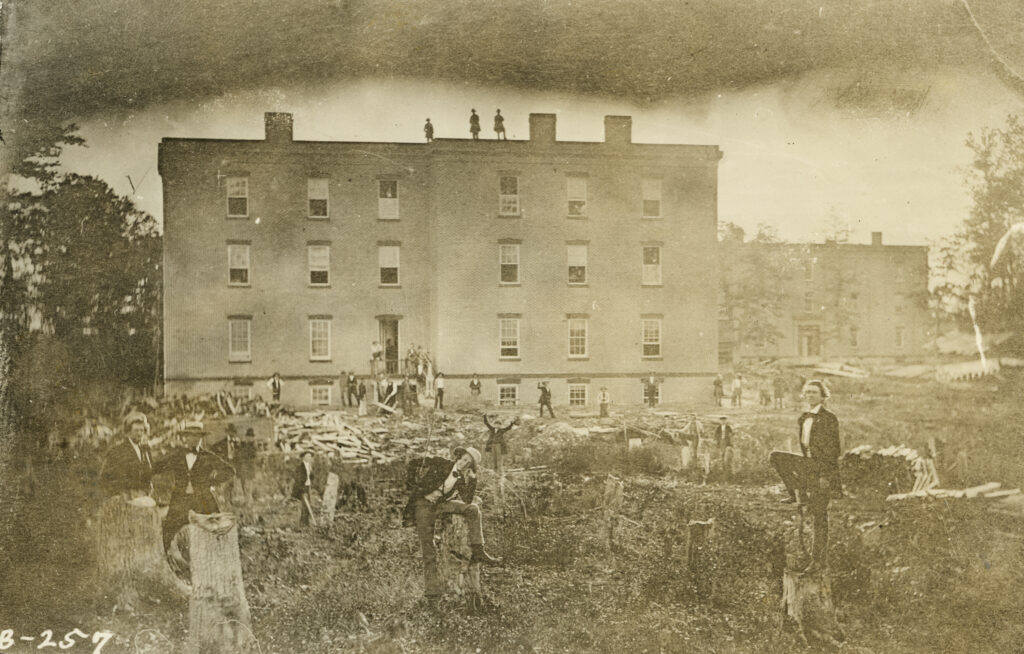
    Michigan Agricultural College first men’s dormitory, later given the name Saints’ Rest. 
    (Michigan State University Archives and Historical Collections, A002337, reproduced with permission)
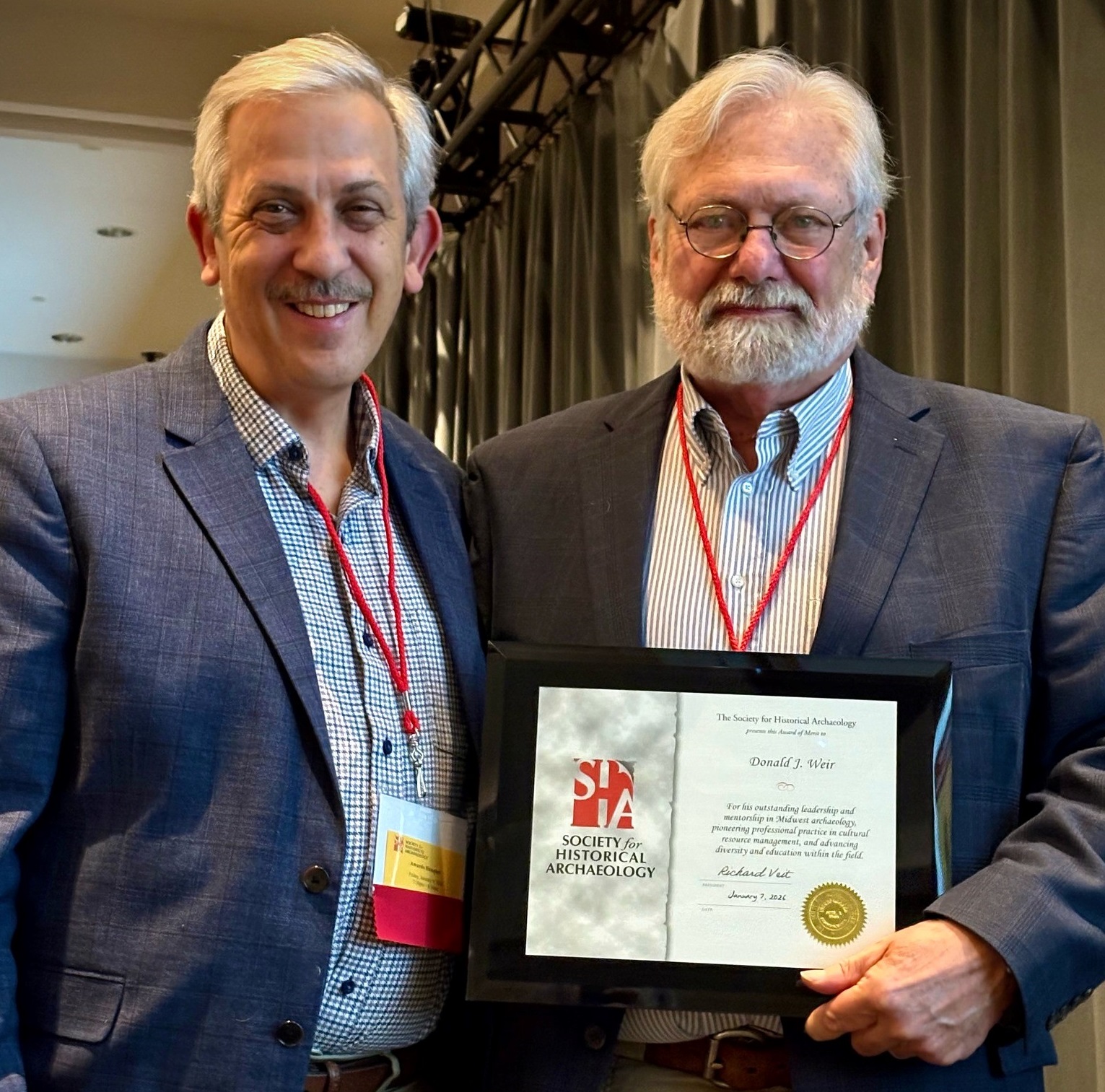
  • Anthropology alumnus wins Award of Merit from Society for Historical Archaeology

    Anthropology alumnus wins Award of Merit from Society for Historical Archaeology

    Donald Weir, a 1974 Anthropology master’s graduate, has been presented with the national Society of Historical Archaeology’s Award of Merit for his lifetime of work in archaeology at this year’s national conference.

    The SHA Awards of Merit were established in 1988 to recognize the specific achievements of individuals and organizations who have furthered the cause of historical archaeology.

    “Donald J. Weir (was selected) for his outstanding leadership and mentorship in Midwest archaeology, pioneering professional practice in cultural resource management, and advancing diversity and education within the field,” the SHA 59th Annual Conference on Historical and Underwater Archaeology program proclaimed.

    The award ceremony took place Jan. 10 in Detroit.

    “The SHA award given to me in Detroit is very special to me,” Weir said. “My dad was an avocational archaeologist and I spent much of my youth going to archaeological meetings at Wayne State University. Early in my professional career with the late Steve Demeter, I worked on several Detroit archaeological projects including the People Mover. My last large project before retirement was the Gordie Howe International Bridge to Canada.”

    Weir, who also earned a bachelor of science degree in Interdisciplinary Social Sciences from MSU, is the founder and former CEO of the Commonwealth Cultural Resources Group.

    He has set up the Commonwealth Heritage Group Diversity Scholarship Award in Archaeology at MSU for undergraduate and graduate students who are or who have been enrolled in archaeology courses offered by the Department of Anthropology.

    “Diversity is a big issue in archaeology and anthropology, especially in archaeology,” he said. “When I went into the profession, it was 90% white male, and it’s now probably 60% female, 40% male, but still 90% white. So I want to encourage diversity in the profession, and I think the profession lacks that, and it will be to the betterment of society, and it’s important to have diversity in archaeology especially with indigenous archaeologists.”

    In October 2021, Weir received the Distinguished Career Award from the Michigan Archaeological Conference (MAC) which recognizes archaeologists who have demonstrated excellence and contributed significantly and regularly to the advancement of Midwestern archaeology.  He was awarded the 2010 McGimsey-Davis Distinguished Service Award by the Register of Professional Archaeologists, the 2017 ACRA Lifetime Achievement Award by the American Cultural Resources Association, and the 2018 Lifetime Achievement Award from the Michigan Historic Preservation Network.

    By Karessa Weir

  • Prior To European Contact Maize In The Central Andes Was Bred To Be Sweeter And Resist Harsh Highland Environment

    Prior To European Contact Maize In The Central Andes Was Bred To Be Sweeter And Resist Harsh Highland Environment

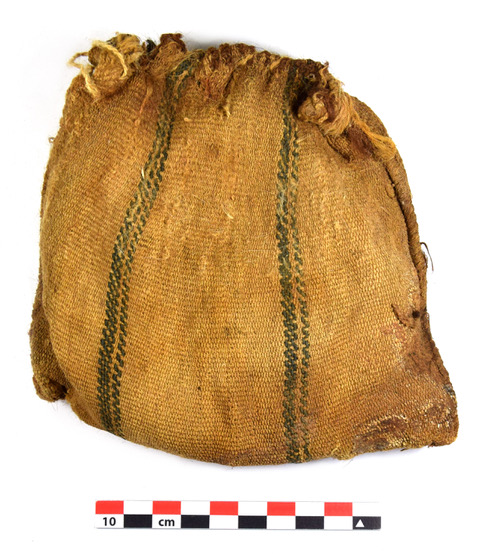
    Genetic analysis of ancient maize placed as an offering alongside the mummified remains of a young 15th-century Andean girl in what is now Bolivia is shedding new light on how regional interactions in the central Andes contributed to the development of maize as a staple crop prior to European contact. The study’s authors include Dr. Huan Chen (lead author), a postdoctoral fellow in Plant, Soil, and Microbial Sciences; Dr. Gabriel Wrobel, Professor of Anthropology; and Dr. William Lovis, Professor Emeritus of Anthropology, along with other Michigan State University colleagues in the plant sciences and collaborators from the Universidad Mayor de San Andrés (Bolivia), Queensland University of Technology (Australia), and the University of Tennessee.

    In the new study “Fifteenth century CE Bolivian maize reveals genetic affinities with ancient Peruvian Maize,” published in the electronic journal eLife (November 2025) the international research team analyzed the genome of exceptionally well-preserved maize found in a stone burial tower or chullpa. By comparing it to samples from 16 previously published datasets spanning more than 5,000 years of evolution, the team uncovered evidence of complex pre=European gene flow and selective breeding strategies in the Andes.

    The maize kernels and the pouch (Photos taken by Dr. Wrobel cand Dr. Lovis)

    The results show that the Bolivian maize was genetically most similar to archaeological samples from ancient Peru, all ultimately derived from maize domesticated in central Mexico. The genome also reflects gene flow from what is now Chile—changes that appear to coincide with the expansion of the Inca Empire across the altiplano region.

    Importantly, the Bolivian maize exhibits genetic modifications associated with traits selected by ancient Central Andean farmers; a shorter growing season, increased drought resistance, and a sweeter flavor profile. These traits suggest sophisticated local breeding practices aimed at improving both the yield and quality of maize.

    While most genomic studies of maize have focused on its initial domestication around 9,000 years ago and early dispersal across Central and North America, this research stands out for highlighting later, regionally driven processes of crop improvement. It offers valuable insight into the biocultural role that diverse cultures and environments played in shaping the genetic variety of maize across South America.

    The article can be accessed at DOI: https://doi.org/10.7554/eLife.106818.

    By Dr. Gabriel Wrobel and Dr. William Lovis

  • New book unpacks the immigrant story behind America’s Mother of the Year 

    New book unpacks the immigrant story behind America’s Mother of the Year 

    In 1952, Toy Len Goon, a Chinese immigrant widow raising eight children, was selected as U.S. Mother of the Year by the American Mothers Committee of the Golden Rule Foundation. Her story, celebrated during the Cold War as proof of American democracy, is featured in a new book by Dr. Andrea Louie, Goon’s granddaughter, and professor and chair of Michigan State University’s Department of Anthropology.   

    Louie’s book, Chinese American Mothering: Toy Len Goon’s Legacy and the Myth of the Model Minority, gives her grandmother the chance to tell her story through her own experiences, not just through the lens of Cold War propaganda. The book uses immigration documents, family interviews, news articles, and secondary sources to illustrate the story of Goon’s struggles and successes alongside the public narrative that framed her as a symbol of democracy triumphing over communism.   

    “I grew up knowing the story but hadn’t really thought about its larger historical significance,” Louie said. “There are lots of layers and different perspectives that I bring into conversation in the book—not only how my grandmother’s story was told by the media, but also how she told her own story to her family.” 

    She describes her book as an ethnography of the model minority myth, told through the life of her grandmother, whose story played a role in shaping it.   

    The book examines how her maternal grandmother’s life was portrayed in the media and used by politicians to promote an image of opportunity in the United States. It also explores the evolution and impacts of the model minority myth, a stereotype created during this time and framed Asian Americans as inherently successful, intelligent and hardworking minorities.  

    “The danger of the myth is that the stereotype paints Asians as rule-followers who do everything right and succeed—suggesting that other minorities aren’t working hard enough,” Louie said. “It also minimizes the structural challenges that Asian Americans face and oversimplifies and homogenizes their experiences.”  

    Journey to the United States: A New Chapter in Maine  

    When Goon was 10-years-old, she was placed with another family—a choice her mother made not only out of financial hardship but from a desire to give her daughter the best chance at success. She married in 1921 and moved to the United States, settling in Maine, where Goon and her husband ran a hand-laundry while raising their eight children. After her husband died in 1941, Goon assumed full responsibility for the family business, managing the laundry and supporting her children.

    When Goon was named Mother of the Year, Louie said media coverage highlighted specific aspects of her grandmother’s life, including her husband’s veteran status and her role as a businesswoman. Stories also emphasized that she successfully raised eight children who were on their way to professional careers, portraying her as proof of the American dream.   

    “(Her story) was convenient for the media to highlight a Chinese American widow and her thriving family as proof of U.S. democracy—especially after the communist takeover of mainland China in 1949.” Louie said. “The assumption was that, had Goon and her family remained in China, they would not have fared as well.” 

    In reality, Louie said their lives were deeply shaped by both the U.S. and Chinese states. 

    Breaking the myth  

    Louie discusses how the ‘model minority myth’ still affects Asian Americans today, but has changed over the years. Through interviews with Goon’s children and grandchildren, she sheds light on how the myth has evolved, and how newer versions continue to affect the Goon family. She notes that Goon’s grandchildren push back against the idea of being stereotypically successful model minorities, viewing themselves as different from post-65 immigrants, due to their grandmother’s modest upbringing.   

    Unlike many recent Asian immigrants who push their children toward top colleges, Goon didn’t realize college was an option for her children until a school principal helped her oldest son, who had taken time off from high school to help in the family laundry, secure a scholarship to Syracuse University.  

    “My grandmother understood that each grandchild had their own strengths,” Louie said. “She accepted us for who we were instead of expecting us to fit into a single success model.” 

    In telling her grandmother’s story, Louie hopes readers will see beyond stereotypes and seek to understand the complexities behind the model minority myth, particularly as it is intertwined with broader questions about migration, gender, assimilation, Americanization, and “success.” 

    “The model minority myth adds a lot of pressure to people,” she said. “It makes them out to be machines, not individuals.”  

    Louie emphasizes that Toy Len Goon was an extraordinary individual whose story is flattened in its framing by the model minority myth that focused only on her success as an assimilated American mother.  

    “My grandmother was a forward thinker,” Louie said. “She wasn’t just an American mother — she was also a businesswoman who worked hard to maintain connections to the Chinese American community and to her family back in China.”

  • New Research Associate Joins MSU’s MOSAIC Project

    New Research Associate Joins MSU’s MOSAIC Project

    What began as a childhood interest in studying the past and human remains has led Dr. Andrea Zurek-Ost to a career in forensic anthropology. She joins the Department of Anthropology as a research associate working on MOSIAC, or Methods of Sex, Stature, Affinity and Age for Identification through Computational Standardization, a project funded by a $2.1 million National Institute of Justice grant.

    Zurek-Ost, originally from Kalamazoo, Michigan, developed an interest in anthropology at a young age. In first grade, she recalls learning about the excavation of King Tutankhamen and being fascinated by archaeology, mummies, and the study human remains. In high school, her interests shifted toward health sciences. During an anatomy class, her teacher tasked each student with interviewing a health professional. Zurek-Ost wanted to speak with someone who worked with the deceased.

    After calling several police departments for leads, she was connected to a graduate student in Michigan State University’s anthropology department. Zurek-Ost was invited to the MSU Forensic Anthropology Lab (MSUFAL) and immediately fell in love with the field.

    “I was hooked from that moment,” she said.

    Now back in her home state, Zurek-Ost is working with Dr. Joe Hefner, lead principal investigator for MOSIAC. The project involves collecting data from thousands of donor skeletons using a variety of methods. That data will help to develop and train a program that considers information related to the four main parameters of the biological profile: stature, sex, age and population affinity. The program will combine that data into a single algorithm, which will be used to more quickly and accurately bring names to unidentified individuals.

    “The unique part of the MOSAIC project will be the way that several different methods come together to produce a holistic biological profile,” Zurek-Ost said. “Something like this has never been attempted at this scale in forensic anthropology.”

    Zurek-Ost completed her undergraduate degree from Central Michigan University, her master’s in forensic and biological anthropology at Mercyhurst University, and her Ph.D. in anthropology this past May from the University of North Carolina at Chapel Hill. Her dissertation work focused on archaeologies of warfare, pilgrimage and ephemerality at a site in the Basque Country in northern Spain.

    Drawn to MOSIAC for the opportunity to engage in collaborative and multi-institutional research, Zurek-Ost brings years of experience in skeletal analysis, especially skeletal measurements and morphological assessments—skills essential for constructing a biological profile.

    For the MOSAIC project, Zurek-Ost is responsible for coordinating with the managers of donated skeletal collections, facilitating data collection trips, determining sampling strategies, and disseminating the results of the research, including writing grant reports.

    “Forensics makes a difference to individuals and also to communities on a larger humanitarian scale,” Zurek-Ost said. “It’s a beautiful thing when a passion you have can positively impact other people.”

    Outside of work, Zurek-Ost enjoys photography, playing the piano and guitar, and consulting on bioarcheological projects in Iraqi Kurdistan and Spain. She also mentors students interested in gaining experience with forensic science research.

    Zurek-Ost said she is looking forward to the mentoring aspect of MOSIAC.

    “Any way you can incorporate compassion into your work is incredibly powerful—it impacts everyone you work with,” she said.

    By Louise Henderson

  • A look inside ANP 364: Fake Archaeology

    A look inside ANP 364: Fake Archaeology

    This semester, Dr. Madeline Mackie challenged students to examine the pseudoarchaeological claims made about the past in ANP 364: Fake Archaeology. Students explored topics from ancient aliens and Atlantis to mysterious megalithics and pyramids. While dissecting archaeological myths, frauds, and hoaxes, Mackie has guided students in learning how to identify false claims and understand why these ideas gain traction in popular media. Additionally, this course emphasizes the accurate methods used to reconstruct the past.

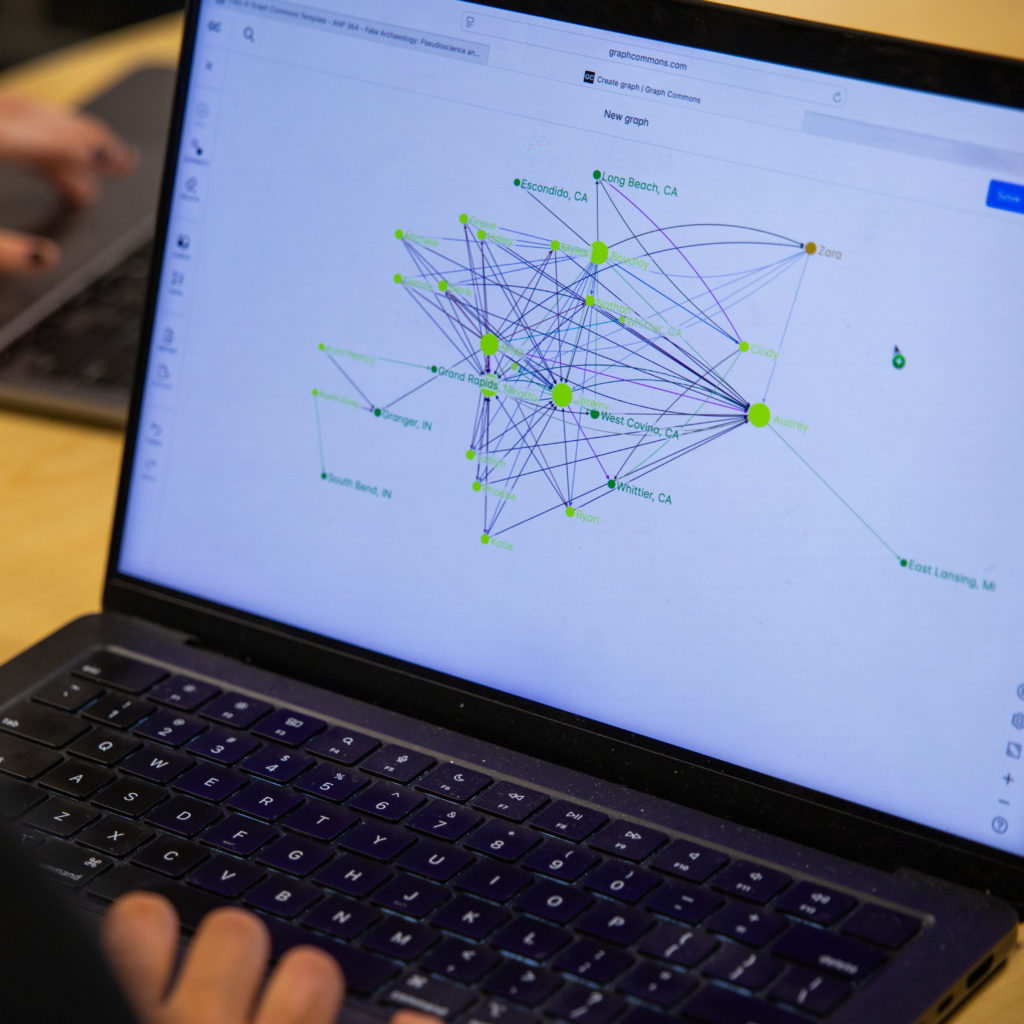
    During this class session, students worked in the Lab for the Education and Advancement of Digital Research (LEADR) on their projects which analyze how social media communicates real and pseudoarchaeological claims. While in LEADR, Bryttany Grimes, a Ph.D student in MSU’s Department of History, provided students with instruction on the technical and digital skills needed to create network graphs mapping hashtags from various archaeological posts.

    “The goal of the project is for students to critically think about how we reconstruct past human lives, what are good sources of archaeological information, potential biases, and how to evaluate information found in public spaces like social media,” Mackie said.

    Read more about Mackie’s teaching philosophy and how this course prepares students for their future.

    Why do you feel it is important to provide students with hands-on experiences?

    The most impactful experiences I had as an undergraduate were hands-on research projects. As a professor, I find LEADR to be incredibly impactful for student learning because it allows me to incorporate digital tools into the classroom even if they lie outside my technical expertise. LEADR helps train students in the nuts and bolts of how the digital methods work, while I can focus on the quality of the content students are producing and referencing.

    How do you see this class preparing students for their future careers or professional goals?

    The class builds transferable skills valuable for students of any career path. Particularly, the course encourages students to think critically about identifying credible information and developing media literacy by dissecting how information spreads. We also spend time talking about ethics in communication and the consequences of the popularization of inaccurate claims.

    What’s the biggest takeaway you hope students leave this class with?

    I hope students leave with tools to evaluate evidence to determine the legitimacy of a claim. In today’s digital world, where we are often overwhelmed by content, it’s more important than ever to be able to critically evaluate information. I also hope they leave with an appreciation for the amazing history, ingenuity, and capabilities of humans around the world. Many of the claims we learn about in class ignore or decenter human ingenuity resulting in devaluation of human history and can intentionally or unintentionally cause real harm, particularly to descendant populations. 

    What has been your favorite part of teaching ANP 364?

    I have been joking that this class is like one giant rabbit hole. Many of the pseudoarchaeological claims we go over in class have deep historical routes with their own interesting, and occasionally infuriating, connections. Likewise, the class offers the opportunity to cover some of the most fascinating materials from the archaeological record like Egyptian pyramids, Göbekli Teppe, Stonehenge, Indigenous earthworks, and more.

    By Louise Henderson

  • MSU Museum Welcomes Dr. Stacey Camp as Curator of Archaeology

    MSU Museum Welcomes Dr. Stacey Camp as Curator of Archaeology

    The Michigan State University (MSU) Museum is pleased to announce the appointment of Dr. Stacey Camp as Curator of Archaeology. An accomplished historical archaeologist and professor in MSU’s Department of Anthropology, Dr. Camp brings a wealth of experience in research, teaching, and public engagement focused on immigration, identity, and labor in the United States. 

    “The MSU Museum’s curatorial team continues to expand in ways that strengthen our interdisciplinary approach and deepen our community connections,” said Devon AkmonDirector of the MSU Museum. “Dr. Camp’s expertise in archaeology and material culture will enrich our collections, exhibitions, and research, while advancing our mission to serve as a collaboratory at the nexus of arts, sciences, cultures, and technologies.” 

    As Curator of Archaeology, Dr. Camp will oversee the Museum’s extensive archaeological collections and support research and exhibitions that illuminate diverse histories through material evidence. Her scholarship explores how race, gender, class, and citizenship shape the lived experiences of individuals and communities, particularly within the context of immigration and labor. 

    Dr. Camp currently directs the Campus Archaeology Program at Michigan State University, which trains students in archaeological fieldwork and research while preserving the university’s cultural heritage. Her ongoing project, the Kooskia Internment Camp Archaeological Project, examines the archaeology and history of Japanese Americans who were incarcerated during World War II through collaboration and interdisciplinary study. 

    An active contributor to the broader archaeological community, Dr. Camp’s work has been featured in numerous academic publications and public forums. She has received national recognition for integrating community-engaged scholarship with archaeological research, emphasizing inclusive practices and diverse narratives in interpreting the past. 

    Dr. Camp joins the MSU Museum as it prepares to reopen in January 2026 following a major renovation. Her appointment reinforces the Museum’s commitment to advancing interdisciplinary research, collections stewardship, and public engagement that align with MSU’s land-grant mission.

    By Louise Henderson  

  • Gungun Islam Awarded Dr. Delia Koo Scholarship for Research on Reproductive Health in India

    Gungun Islam Awarded Dr. Delia Koo Scholarship for Research on Reproductive Health in India

    Congratulations to Gungun Islam, anthropology graduate student, on receiving the Dr. Delia Koo Global Student Scholarship. This award supports her ethnographic fieldwork in West Bengal, India, where she is examining the complex inequities found within infertility.

    “In India, infertility is never just a biomedical issue,” Islam said. “It is deeply political—shaped by intersecting structures of sociocultural, economic, environmental, and political inequalities.”

    Her research investigates how assisted reproductive technologies (ART), while expanding possibilities for conception, remain largely inaccessible to many marginalized women. Islam noted that these women are faced with systematic neglect, religious prejudice, and humiliation in clinical settings all of which constrain their access to care.

    “For rural women, these challenges are even greater,” Islam said. “With limited local healthcare, they must rely on urban facilities, often at significant financial and emotional cost. At the same time, community stigma heightens their isolation and leaves them at greater risk of violence.”

    With support from this scholarship, Islam will continue her fieldwork with the goal of raising awareness about reproductive health inequities and advocate for accessible and community-driven care.

    Images taken during Islam’s preliminary fieldwork in West Bengal, India, 2025.

    The photos above emphasize the relationship-building conversations that took place during Islam’s preliminary fieldwork.

    “This stage of research is less about collecting data and more about listening deeply, allowing the research to be guided by women’s own realities,” Islam said.

    by Louise Henderson

  • What ancient Indigenous cuisine can teach us about culture and community 

    What ancient Indigenous cuisine can teach us about culture and community 

    A new collection of original essays, “Ancient Indigenous Cuisines: Archaeological Explorations of the Midcontinent,” is the first to examine trends in ancient Indigenous foodways across the region. This volume, a collaborative effort by Dr. Jodie O’Gorman, former chair and associate professor in Michigan State University’s Department of Anthropology, and Ph.D. alumni Dr. Susan Kooiman and Dr. Autumn Painter, explores the concept of cuisine and its connections to social experience—how what people ate shaped and reflected their lives. 

    Recognizing overlapping research interests, O’Gorman, Kooiman, and Painter brought together scholars studying an array of related topics in a variety of cultural contexts. Their goal was to pool insights, expand available data and share findings through a comprehensive collection of essays on midcontinental archaeological foodways. 

    As Kooiman, O’Gorman, and Painter explain in the Introduction, “This volume features archaeological explorations of the cuisines of ancient Indigenous peoples of the Midcontinent of North America, examined through a range of cutting-edge methods and perspectives and exemplifying a wide range of questions and outcomes that demonstrate the versatility and strength of culinary studies.”

    The editors stress that food can be used to gain insight into many different aspects of any culture. Beyond the basic questions of what people from a particular place and time ate, food can be used to address questions of economics, socio-politics, identity, health, religion, environment, and more.

    To investigate dietary practices from thousands of years ago, researchers used a range of methods that build on fundamental identifications of plant and animal remains. These included detailed contextual analysis, identifying microscopic residues and use-wear found on pottery and other tools, and use of experimental studies. Contributors focused not only on what resources people used, but also choices about that food and the dynamic relationships of food with society.   

    Each chapter in “Ancient Indigenous Cuisines” uniquely approaches social issues through the lens of food. For example, in her own research collaboration with MSU Ph.D. alum Dr. Jeffrey Painter on Morton Village collections, O’Gorman was surprised by the “powerful role” cuisine played in social negotiations among groups within the village. In Kooiman’s  chapter with MSU undergraduate alum Rebecca Albert, she reveals how the importance of maize and wild rice in local cuisine shifted over time in northern Michigan.

    The MSU scholars hope readers come to understand that our lives are in many ways centered around food and that food not only represents who we are in a certain time and place, but plays an important role in how we shape and transform social identities.

    by Louise Henderson

  • Language and Peacebuilding: Indonesian Youth Counter Conflict Through Creativity

    Language and Peacebuilding: Indonesian Youth Counter Conflict Through Creativity

    A new arts-based research project reveals how young people in Ambon, Indonesia are transforming language into a tool for unity and healing.

    Associate Professor of Anthropology, Dr. Elizabeth Drexler, co-authored a new study titled Language and Conflict De-escalation: Preserving peace in Ambon through literature and art. In collaboration with Dr. Wening Udasmoro, Professor of Literature and Gender and Vice Rector of Education and Learning at Universitas Gadjah Mada, and Mariana Lewier, lecturer at Pattimura University in Maluku, the team examined how the youth of Ambon approach social issues related to peace, justice and human rights.

    Despite its now vibrant cultural identity, the region has also experienced religious conflict, particularly following the end of Indonesia’s authoritarian rule in 1998. While previously communities had lived together peacefully for decades, tensions escalated in the early 2000s.

    According to the study, language—including rumors and misinformation—was used to fuel conflict. Indonesia has reported numerous cases in which online agitation has led to direct physical violence toward youth.

    Through conversations with members of the current youth arts community, the researchers identified ways in which musicians, artists and writers were approaching this conflict differently than previous generations.

    To promote de-escalation, Drexler explained that in the early 2000s the Ambon youth began countering disinformation and emphasizing local context. Their approach stood in contrast to outside media, which often lacked context and presented issues in a polarized way.

    “Language is often seen as a force that incites violence,” Drexler said. “We saw an opportunity to highlight how these youth had used a force (language) often used for violence, to promote peace.”

    Today’s Indonesian youth take de-escalation a step further. They create art and music together in mixed communities, including with groups their communities were once in conflict with. Rather than use language exclusive to their own communities, they focus on building trust and demonstrating that peaceful collaboration is possible.

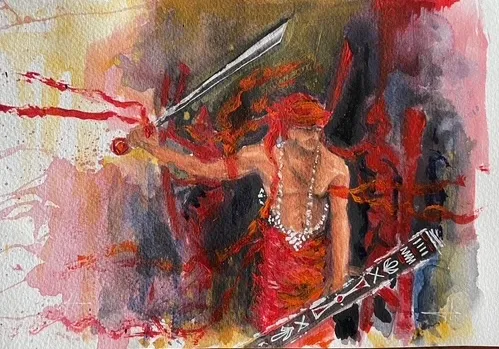
    Watercolor paintings by: Helmi Ishak Johannes (Instagram: @miidraw)

    Ambon, Drexler explained, is an example of a city that used the arts to bring communities together and provided youth with economic and social opportunities. By focusing on the arts, young people have been able to create new identities and livelihoods that do not focus on past conflicts.

    “They made decisions to intervene in these cycles and use language and art communities in ways that would counter practices of fear, othering and polarization which allowed them to also build successful livelihoods,” Drexler said.

    By Louise Henderson