
The Department of Anthropology is very pleased to announce that PhD Student Emily Riley has been awarded a Fulbright-Hays Doctoral Dissertation Research Abroad. Emily’s research, entitled “The Fight Against Wastefulness’: Legal and Political Engagement in Senegal,” will investigate the legal and political efforts for social change in Senegal, specifically examining the history and current impacts of the law of 1967 that reprimands excessive spending for family ceremonies and subsequent campaigns to revive it. Emily will examine the state, religious, and non-governmental intersections regarding the law, and will then analyze them in relation to broader questions of economic development, gender relations, social change, fiscal policy, and state-citizen relations.
-
Department of Anthropology Sponsors Interdisciplinary Graduate Student Conference on Migration
The Department of Anthropology is happy to announce that it will be sponsoring Migration without Borders, an interdisciplinary graduate student conference on migration at Michigan State University on October 5th & 6th.
This conference aims to facilitate and foster an interdisciplinary, trans-institutional cohort of scholars interested in issues of migration and mobility. Panelists are scholars at various stage in their graduate careers, working on a plethora of thematic, conceptual, spatial, and temporal aspects of migration, from numerous disciplinary perspectives and regional backgrounds. Topics include the intersection of migration with health, youth, the state, gender, and development.
Attendance at the conference is free and open to the public.
For more information, please visit the conference website at http://migrationconferencemsu.wordpress.com
-
Dept of Anthropology Morton Village Archaeological Fieldschool Launches Blog
 In order to document and communicate their ongoing research and outreach activities, the MSU Department of Anthropology Morton Village Archaeological Fieldschool in launching a blog this season. Located at mortonvillage.anthropology.msu.edu, the blog will feature regular posts and videos by fieldschool staff and students.
Located in the central Illinois River Valley near Lewiston, Illinois, the Morton Village Site is a late prehistoric village. This cooperative project with the Illinois State Museum focuses on the A.D. 1300-1400 community associated with a period of social integration and conflict among Oneota and Mississippian groups.
-
Terry Brock Receives Dissertation Research Grant
Congratulations to Terry Brock on being awarded an SRI Foundation Dissertation Research Grant for his research entitled: “We All Walked Together”: The Transition From Slavery to Freedom on a 19th century Maryland Plantation.
-
“ANP 464: Archaeology Field School” Receives Honorable Mention
Dr. Lynne Goldstein and Terry Brock (PhD Candidate) received an honorable mention for the 2012 AT&T Faculty – Staff Award Competition in Instructional Technology. They received this honorable mention for their development of ANP 464: Archaeology Field School, which aims to engage the public with archaeology.
-
Sean Dunham is Recipient of Prestigious Award
Sean Dunham (PhD Candidate) is the recipient of the Society for American Archaeology Student Paper Award for the paper titled “Late Woodland Landscapes in the Eastern Upper Peninsula of Michigan.” Sean was presented with this award at the 77th Annual Meeting of the Society for American Archaeology, a national organization, in Memphis, TN on April 20th, 2012. This paper is part of Sean’s ongoing dissertation research that examines settlement and subsistence practices in the Eastern Upper Peninsula of Michigan.

-
Undergraduate Students Present Research
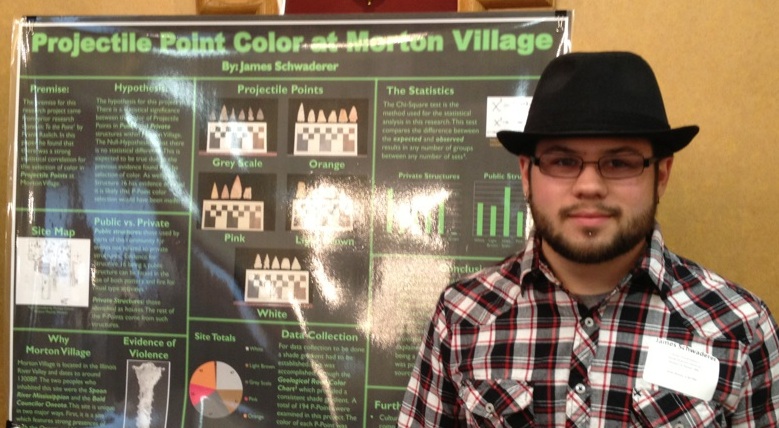
On Friday, April 13th, 2012, eight undergraduate students presented their research at the annual University Undergraduate Research and Arts Forum (UURAF) at MSU.

James Schwaderer presented his winning poster: "Projectile Point Color at Morton Village" James Schwaderer: “Project Point Color at Morton Village” (Winning Poster) – Advisor: Dr. Jodie O’Gorman
Janine Baranski: “A Study of the Associations between Offspring Survival and Birth Order, Offspring Sex and Previous Siblings in Rural Communities of Kenya” – Advisor: Dr. Masako Fujita
Kaitlin A. Scharra: “Understanding Non-Elite Mississippian Societies: A Mortuary Analysis of the East St. Louis Stone Quarry Site Cemetery” – Advisor: Dr. Lynne Goldstein
Circe Wilson: “Using Ceramics to Understand MSUs Past” – Advisors: Dr. Lynne Goldstein and Katy Meyers
Ryan Jelso: “Architectural Variation at Morton Village” – Advisor: Dr. Jodie O’Gorman
Josh Lieto: “The Broad-Rimmed Bowl: A Descriptive Study and Analysis” – Advisor: Dr. Jodie O’Gorman
Josh Lieto: “Prehispanic Chocolate for Tarascan Kings: Detection of Cacao in Spouted Elite Serving Vessels” – Advisor: Dr. Helen Pollard
Rachel Wise: “Identifying Different Cultural Groups at a Multi-Ethnic Archaeological Village” – Advisor: Dr. Jodie O’Gorman
-
Tazin Karim awarded Disciplinary Leadership Endowment Fellowship from the Council of Graduate Students and the Graduate School
Tazin Karim, doctoral candidate in medical anthropology, was recently awarded the Disciplinary Leadership Endowment Fellowship from the Council of Graduate Students and the Graduate School. This award recognizes her participation and demonstrated leadership in the field of anthropology including professional societies at the local, national and international levels. In particular, Taz was acknowledged for her involvement with the Society for Medical Anthropology and her role as chair of a special interest group on Alcohol, Drugs and Tobacco Research.
-
PhD Candidate Adrianne Daggett Awarded NSF Doctoral Dissertation Improvement Grant
The Department of Anthropology is very pleased to announce that Adrianne Daggett (PhD Candidate) has just been awarded an NSF Doctoral Dissertation Improvement Grant for her project titled “Early Iron Age Social and Economic Organization in Sowa Pan, Botswana.”
Adrianne will conduct archaeological survey and excavation at two sites near the present-day village of Mosu in northeastern Botswana. This project will investigate economic behavior and settlement organization patterns at these sites to understand the relationship between prehistoric farming settlements of this area and the emerging state-level societies of the time. The project will also investigate whether hunter-gatherers interacted with the Mosu farming settlements, and if so, how they may have contributed to the regional political economy. The research will take a critical look at the late first millennium AD, a crucial period of southern African prehistory during which complex societies and intercontinental trading networks were emerging. Fieldwork will be conducted in an area far from the Shashe-Limpopo Basin, the locale generally considered to be the center of cultural, political, and economic developments for this time period. Because of the distances between communities and the relative parity in natural resources among areas, reason exists to question the presumptions that the Shashe-Limpopo Basin claimed predominance in the southern African political economy from the earliest times, and that all communities of the late first millennium exercised the same cultural and social practices. Comparative research of this kind will improve understanding of the relationship between populated areas in prehistoric southern Africa as well as of localized processes of social and economic development.
-
Dr. Monir Moniruzzaman infiltrates illegal organ trafficking market
EAST LANSING, Mich. — A Michigan State University anthropologist who spent more than a year infiltrating the black market for human kidneys has published the first in-depth study describing the often horrific experiences of poor people who were victims of organ trafficking.
Monir Moniruzzaman interviewed 33 kidney sellers in his native Bangladesh and found they typically didn’t get the money they were promised and were plagued with serious health problems that prevented them from working, shame and depression.
The study, which appears in Medical Anthropology Quarterly, and Moniruzzaman’s decade-long research in the field describe a growing worldwide market for body parts that include kidneys, parts of livers and even corneas.
Moniruzzaman said the people selling their organs are exploited by unethical brokers and recipients who are often Bangladeshi-born foreign nationals living in places such as the United States, Europe and the Middle East. Because organ-selling is illegal, the brokers forge documents indicating the recipient and seller are related and claim the act is a family donation.
Doctors, hospital officials and drug companies turn a blind eye to the illicit act because they profit along with the broker and, of course, the recipient, said Moniruzzaman, who questioned many of the people involved.
Most of the 33 Bangladeshi sellers in his study had a kidney removed across the border in India. Generally, the poor seller and the wealthy recipient met at a medical facility and the transplant was performed at that time, he said.
“This is a serious form of exploitation of impoverished people, whose bodily organs become market commodities to prolong the lives of the wealthy few,” said Moniruzzaman, assistant professor in the Department of Anthropology and the Center for Ethics and Humanities in the Life Sciences.
Moniruzzaman recently delivered his research findings and recommendations on human organ trafficking to both the Tom Lantos Human Rights Commission of the U.S. Congress and the U.S. Senate Committee on Foreign Relations.
His briefing included the experiences of Mehedi Hasan, a 23-year-old rickshaw puller who sold part of his liver to a wealthy recipient in the Bangladesh capital of Dhaka. Like many poor Third World residents, Hasan did not know what a liver was. The broker exploited this fact and told Hasan the sale would make him rich.
The recipient died soon after the transplant. Hasan received only part of the money he was promised and is now too sick to work, walk long distances or even breathe properly. He thinks often of killing himself, Moniruzzaman said.
Organ brokers typically snag the unwitting sellers through deceptive advertisements. One ad, in a Bangladeshi newspaper, falsely promised to reward a kidney seller with a visa to the United States. Moniruzzaman collected more than 1,200 similar newspaper ads for the study; see two examples here.
The organ trade is thriving in Bangladesh, a country where 78 percent of residents live on less than $2 a day. The average quoted price of a kidney is 100,000 taka ($1,400) – a figure that has gradually dropped due to an abundant supply from the poor majority, Moniruzzaman said.
One Bangladeshi woman advertised to sell a cornea so she could feed her family, saying she needed only one eye to see. That transplant didn’t happen, but Moniruzzaman said there have been cases of corneas being sold.
Moniruzzaman said it’s important to note that most sellers do not make “autonomous choices” to sell their organs, but instead are manipulated and coerced. He said the global trade of organs is a fairly recent phenomenon – made possible by advances in medical technology in the past 30 years – that represents a form of gross exploitation unseen in human history.
To combat organ trafficking, he recommends, among other steps:
- Global governance. The U.S. Department of State should play an active role in putting pressure on national affairs and foreign governments to acknowledge the problem and insisting on crackdowns on brokers, recipients, doctors and businesspeople involved in the trade.
- Transparency and accountability. The State Department should ensure all medical centers have a transplantation registry and verify the relationship between recipients and donors.
- Cadaveric donation. Countries such as Bangladesh that do not have a system in which people can donate organs when they die should implement these systems. The United States should provide aid and encourage cadaveric organ donation through educational institutions, news media and religious centers.
Realistically, organ trafficking will never be eliminated, Moniruzzaman told lawmakers on the Human Rights Commission.
“But with our collaborative efforts,” he said, “we can significantly reduce this gross violation of human rights.”
###
Michigan State University has been working to advance the common good in uncommon ways for more than 150 years. One of the top research universities in the world, MSU focuses its vast resources on creating solutions to some of the world’s most pressing challenges, while providing life-changing opportunities to a diverse and inclusive academic community through more than 200 programs of study in 17 degree-granting colleges.
Contact: Andy Henion, University Relations, Office: (517) 355-3294, Cell: (517) 281-6949, Andy.Henion@ur.msu.edu; Monir Moniruzzaman, Anthropology, Office: (517) 355-0189, monir@msu.edu
Published: March 12, 2012
Click here to view original article


