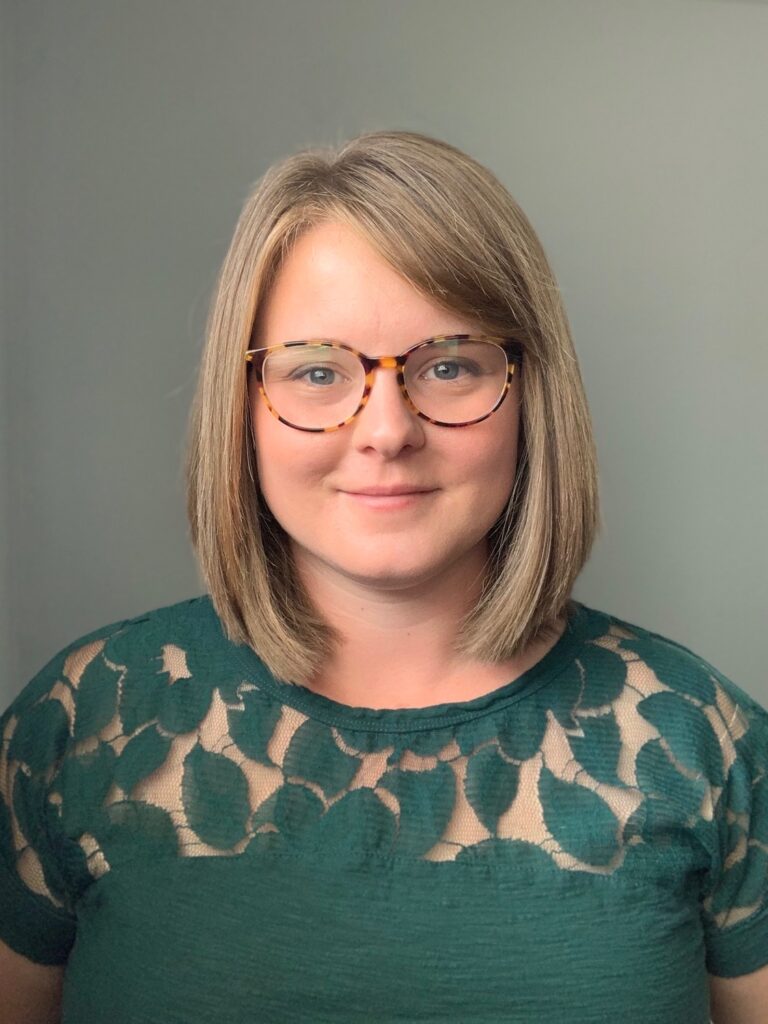
• The Department of Anthropology Welcomes new MSU Museum Archaeology Collections Manager, Samantha Ellens

    The Department of Anthropology Welcomes new MSU Museum Archaeology Collections Manager, Samantha Ellens

    The Department of Anthropology is happy to welcome the new MSU Museum Archaeology Collections Manager, Samantha Ellens. The position of Collections Manager is jointly supported by the MSU Museum and the Department of Anthropology.

    Samantha will be responsible for the care, preservation, and documentation of the archaeological collections that are managed and curated collaboratively by the MSU Museum and the Department of Anthropology.  Samantha will oversee a range of collections activities, including conservation and storage of materials, supervising student volunteers, and managing access to collections for teaching and research.

    Samantha’s background in outreach and museum management brings a community-based approach to her research and contributions to programming, teaching, and collections work focused on fostering lasting appreciation of historic, cultural, and natural resources.

    As a historical archaeologist with a background in Ontario, the Midwest, and the Caribbean, Samantha has over a decade of experience in museum management, collections-based research, and community archaeology. Her research has an emphasis on urban and colonial landscapes, drawing upon many topics including consumption, trade, health, labor, and identity to inform her work in Michigan and the Caribbean. She is currently completing her PhD in Anthropology at Wayne State University with a specialization in historical archaeology.

  • Professor Gabriel Wrobel awarded research grant by the Alphawood Foundation

    Department of Anthropology Professor Gabriel Wrobel has been awarded a research grant by the Alphawood Foundation. This funding is in support of a project based in Northern Belize titled “The Marco Gonzalez Archaeological ProjectExploring Ancient Maya Coastal Adaptations in Northern Belize,” and the research will run in conjunction with an MSU Education Abroad program. The funding will be used for research taking place during the summer of 2024, primarily to support graduate and undergraduate students from Belize that are participating in the project along with funding for specialized analysis.

    The Alphawood Foundation is a private foundation located in Chicago, IL. More information on the foundation can be found here.

  • Associate Professor Chantal Tetreault awarded MSU HARP Award

    Department of Anthropology Associate Professor Chantal Tetreault was awarded a Humanities and Arts Research Development (HARP) Award for 2023 by Michigan State University’s Office of Research and Innovation. Professor Tetreault’s project is titled “What is Arabic Good For? Arabic Language Educational Reform in France” for which she is currently researching.

    HARP funding is designed to support MSU faculty in the development of projects that seem likely to enhance the reputation of both the faculty member and the university, per the website. Further information on the HARP award and 2023 awardees can be located at the link below:

    HARP Development Award Recipients 2023

  • Associate Professor Mara Leichtman Awarded Institute of Advanced Study Fellowship at Durham University

    Associate Professor Mara Leichtman has been awarded an Institute of Advanced Study fellowship at Durham University, UK, where she is in residence at St. Aidan’s College from January through March 2024. During this time, she will be working on her next book titled “Humanitarian Islam: Transnational Religion and Kuwaiti Development Projects in Africa,” which unpacks the micropolitics of Islamic humanitarian giving, and focuses on Kuwaiti Sunni and Shi’i charities operating in Senegal and Tanzania.

    During this residency period, Dr. Leichtman will also be collaborating with Dr. Christopher Bahl from Durham’s Department of History on a project entitled “An Interdisciplinary Rethinking of the Making of Shi‘i Identities beyond the Middle Eastern ‘Centre.’” Their aim is to bring a more diachronic approach to the emergence and transformation of Shi‘i Islamic identities across time and space. They plan to organize an international and interdisciplinary workshop at Durham University, with further plans to publish on the importance of interdisciplinary work in the growing subfield of Shi‘i Islamic Studies.

    For more information: https://www.iasdurham.org/people/current-fellows/dr-mara-leichtman/

  • MSU Biomarker Laboratory for Anthropological Research is seeking mid-Michigan breastfeeding mothers for upcoming study

    Department of Anthropology Associate Professor Masako Fujita, Director of the MSU Biomarker Laboratory for Anthropological Research, is looking for mid-Michigan breastfeeding mothers to volunteer for an upcoming study, “Exploring Human Milk Immune Specificity.”

    Qualifying volunteers will be asked to:
    • Come to Michigan State University East Lansing campus, if possible, with baby – about 2 hours
    • Pump about one ounce of milk (in a private office) and give blood drops via finger stick
    • Answer questions and have their body measurements taken
    We ask volunteers to pump milk at campus, rather than donating frozen milk, to be sure that all the immune factors in milk are still active when we take it into the lab. Participants will receive a $35 Amazon gift card. For more info please email masakof@msu.edu.

  • Associate Professor Masako Fujita Awarded Wenner-Gren Research Grant

    Department of Anthropology Associate Professor Masako Fujita, Director of the MSU Biomarker Laboratory for Anthropological Research, has been awarded the Post-PhD Research Grant by the Wenner-Gren Foundation in support of their new project, “Exploring Human Milk Immune Specificity.”

    Breastfeeding is good for children’s health in many ways. Immune factors in milk—including antibodies and other proteins, white blood cells, and even commensal microbes—protect infants against infections and may prevent allergies. Understanding how the “immune system of milk” responds to microbes is important to understanding how breastfeeding affects children’s health.

    This project will seek to understand how chronic stress mothers experience may affect how the “immune system of milk” responds to microbes. Dr. Fujita hypothesizes that high stress levels would disrupt milk immune specificity, underreacting to harmful bacteria like Salmonella or overreacting to benign microbes like Bifidobacteria, or both.

    The research team includes MSU students Aditi Sharma (Anthropology/Human Biology), Alli Harkenrider (Anthropology/Human Biology), Ananyaa Asthana (Physiology/Health Promotion), Natalie Mourou (Anthropology), and Dr. Katherine Wander of SUNY Binghamton Anthropology.

    Per the Wenner-Gren Foundation website:

    This grant program funds individual research projects undertaken by doctorates in anthropology or a closely related field. Our goal is to support vibrant and significant work that furthers our understanding of what it means to be human. There is no preference for any methodology, research location, topic, or subfield. The Foundation particularly welcomes proposals that integrate two or more subfields and pioneer new approaches and ideas.

    For more information: https://wennergren.org/program/post-phd-research-grant/

  • Associate Professor Joseph Hefner publishes in Bioarchaeology International

    Department of Anthropology Associate Professor Joseph Hefner, along with Dr. Rebecca Redfern of Newcastle University, Professor Sharon N. DeWitte of the University of Colorado, and Professor Dorothy Kim of Brandeis University have published an article in Bioarchaeology International titled “Race, Population Affinity, and Mortality Risk during the Second Plague Pandemic in Fourteenth-Century London, England.”

    Abstract

    We investigate whether hazards of death from plague and physiological stress at a fourteenth-century plague cemetery (Royal Mint, London) differed between populations using N = 49 adults whose affiliation was established using macromorphoscopic traits. Compared to a nonplague cemetery (N = 96), there was a greater proportion of people of estimated African affiliation in the plague burials. Cox proportional hazards analysis revealed higher hazards of death from plague for those with estimated African affiliation. There were higher rates of linear enamel hypoplasia in those with estimated African affiliation, but this finding is not statistically significant. These results provide the first evidence that hazards of plague death were higher for people of estimated African affiliation compared to other affiliations, possibly because of existing inequalities, in addition to migration (free or forced) outcomes. These findings may reflect premodern structural racism’s devastating effects.

    Read the full article here: https://journals.upress.ufl.edu/bioarchaeology/article/view/2403

    This piece has received significant media coverage:

    https://www.foxnews.com/us/new-study-claims-structural-racism-played-role-black-death-plague

    https://www.dailymail.co.uk/news/article-12775007/Black-women-African-descent-likely-die-medieval-plague-structural-racism.html

    https://www.theguardian.com/politics/2023/dec/13/badenoch-condemns-london-plague-study-after-mp-calls-it-woke-archaeology

  • Anthropology Undergraduate Sam Lavake awarded Forensic Sciences Foundation Grant

    Anthropology undergraduate senior Sam Lavake has been awarded a Field Grant by the Forensic Sciences Foundation. This grant will be used to support her Dean’s Assistantship this year. Sam’s research proposal was titled “Validation of Three-Dimensional Photogrammetry Models to Document Cranial Trauma”.

    From the American Academy of Forensic Sciences website: Each year the Forensic Sciences Foundation (FSF) awards monies in the form of grants to members of the forensic science communities to help the investigator/researcher initiate original in-depth, problem-oriented research throughout the year. These grants are open to members and affiliates (at any level) of the American Academy of Forensic Sciences. This year, the FSF Research Committee has awarded three Field Grants and seven Lucas Grants totaling $34,546.

    For more information: Field and Lucas Research Grant Recipients

  • New Book by Associate Professor Dr. Elizabeth Drexler: Infrastructures of Impunity: New Order Violence in Indonesia

    Department of Anthropology Associate Professor Dr. Elizabeth Drexler announces the publication of her new book, Infrastructures of Impunity: New Order Violence in Indonesia, available now from Cornell University Press.

    From the publisher’s website: In Infrastructures of Impunity Elizabeth F. Drexler argues that the creation and persistence of impunity for the perpetrators of the Cold War Indonesian genocide (1965–66) is not only a legal status but also a cultural and social process. Impunity for the initial killings and for subsequent acts of political violence has many elements: bureaucratic, military, legal, political, educational, and affective. Although these elements do not always work at once—at times some are dormant while others are ascendant—together they can be described as a unified entity, a dynamic infrastructure, whose existence explains the persistence of impunity. For instance, truth telling, a first step in many responses to state violence, did not undermine the infrastructure but instead bent to it. Creative and artistic responses to revelations about the past, however, have begun to undermine the infrastructure by countering its temporality, affect, and social stigmatization and demonstrating its contingency and specific actions, policies, and processes that would begin to dismantle it. Drexler contends that an infrastructure of impunity could take hold in an established democracy.

    The book is available directly from the publisher here. Use the code 09BCARD for 30% off.

  • Department of Anthropology Ph.D Candidate Jeff Burnett Awarded Wenner-Gren

    Department of Anthropology Ph.D candidate Jeff Burnett has been awarded the Wenner-Gren Enagaged Research Grant for his proposal titled “Oak Bluffs Historic Highlands Archaeology Project”. For this project Jeffrey will be conducting a landscape study that utilizes archaeological methods, archival data, and oral histories and stories to map the beginnings and growth of a Black vacationing community in the Highlands area of Oak Bluffs, Massachusetts.

    For more information on the Wenner-Gren Engaged Research Grant, please see the following description from their website: This program supports research partnerships that empower those who have historically been the subjects of anthropological research, rather than researchers themselves. Designed in alliance with individuals who have borne the impact of marginalization, these partnerships bring together scholars and their interlocutors in an effort to expand anthropological knowledge, combat inequality, and help communities flourish. The program supports projects that will make a significant contribution to anthropological conversations through collaboration and engagement.

    Anthropological research involves forging ethical relationships. Researchers must acknowledge the contributions of interlocutors and compensate them appropriately for their labor and time. Projects funded by Engaged Research Grants go even further. Not only are interlocutors participants in the research, but they have an active role in determining the problems explored. This grant program targets projects that show greater potential when undertaken as a partnership, beginning with the formulation of research questions and extending to data gathering, skill sharing, scholarly communication, and public mobilization. Engaged research occurs in a broad range of settings, including communities, courtrooms, government offices, and laboratories. It results in findings that are meaningful and potentially transformative for research participants and others with a stake in the collaboration. Through this program, the Foundation seeks to demonstrate how engagement can foster innovation and further anthropological knowledge.

    This program is open to applicants with PhDs in anthropology and related fields. We also welcome applications from students enrolled in a doctoral program (or equivalent, if applying from outside the U.S.) at the time of application. There is no preference for any methodology or subfield. Individuals of all nationalities are eligible to apply.

    Click here for further information.

    For more information on Jeff Burnett’s project, please see the following links to local newspaper stories:

    MV Times

    Vineyard Gazette