• Anthropology Grad Student Spotlight: Kelsey Merreck Wagner – Human-environment relationships and art as activism

    Anthropology Grad Student Spotlight: Kelsey Merreck Wagner – Human-environment relationships and art as activism

    By Katie Nicpon

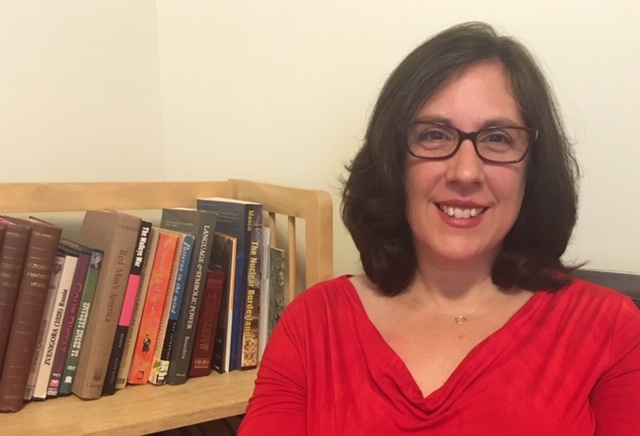
    Passionate about the intersection of people, animals, environment and activism, Kelsey Merreck Wagner is a Ph.D. candidate in the MSU Anthropology program and is also an artist. Since the pandemic, she has been weaving community trash into tapestries and preparing for her dissertation research trip to Thailand in October. 
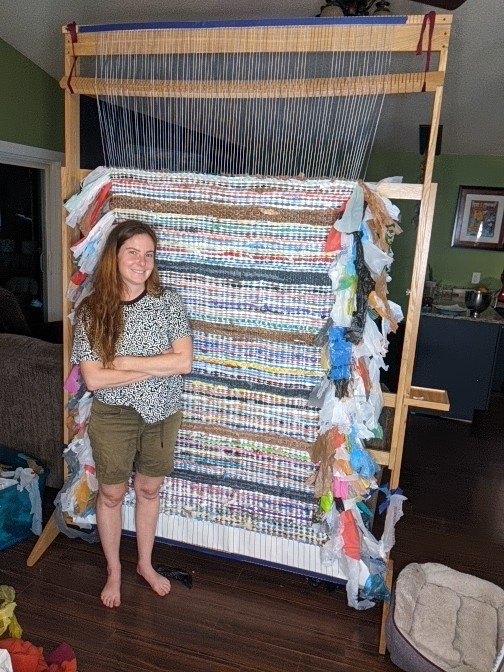
    MSU Anthropology PhD candidate and local artist Kelsey Merreck Wagner stands with her tapestry she wove using plastic. For more of her art, visit her website. Photo credit: Kelsey Merreck Wagner. 

    “I was really drawn to the idea that weavings are inherently based in place because people generally use local fibers, whether it’s from sheep or local plant fibers, and the dyes from their materials come from their local ecosystems,” she said. “I really kind of wanted to do a satirical nod to that by thinking: Okay, what is my place-based weaving as a white woman in America? Plastic. Plastic. Plastic is my local resource that I have so much of. Trash is part of our environment and so plastic really can’t be separated from that. Because once it’s made, once it’s consumed and thrown away, it’s always going to be there. I started weaving with these as an experiment and realized I really loved the textures and patterns.”

    Once she began collecting trash from others, she realized how trash displays intersectional identities in a person or a community such as gender, age, race and class, almost like a portrait. 

    “I also see my art as a call out to these different brands and corporations as kind of an eye opener of how much plastic adds up over time,” she said. 

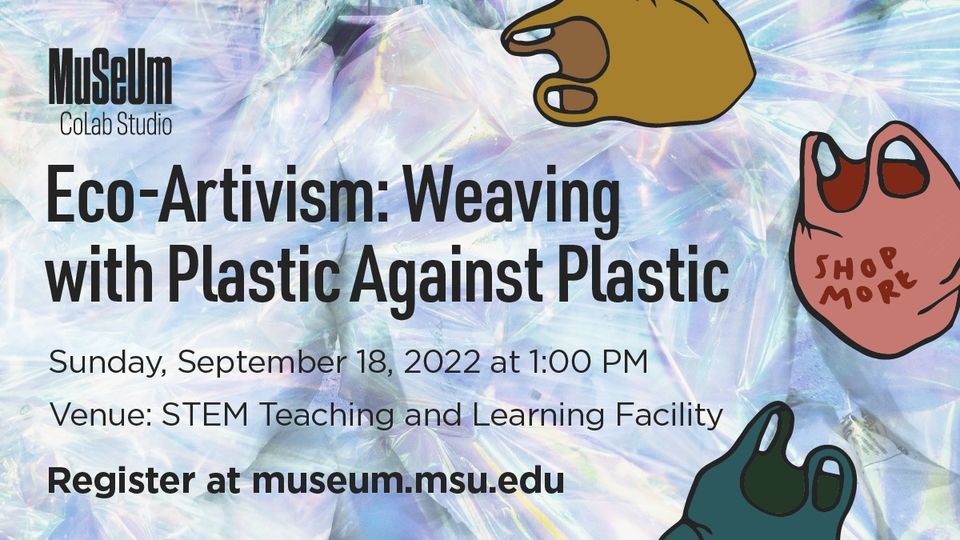
    Her work will be showcased in the upcoming MSU Museum Science Gallery 1.5 ° Celsius exhibition which begins on September 6, 2022, and will last through February 2023. The exhibition will include contributions of more than one dozen national and international artists, scientists, and researchers to help the public explore the global climate crisis. 

    “They also asked me to do a weaving workshop at the STEM building,” Wagner said. “I’m going to be bringing a huge, basic, wooden tapestry loom that I’ll build for this one project. I’ll be bringing in plastic and then workshop participants are also encouraged to bring in any kind of trash that they want to weave with. We’re going to all work together to do a collaborative community weaving and see what we can make. We will be able to think of it as a portrait of the community or of the participants thinking about all the different trash that we use.”
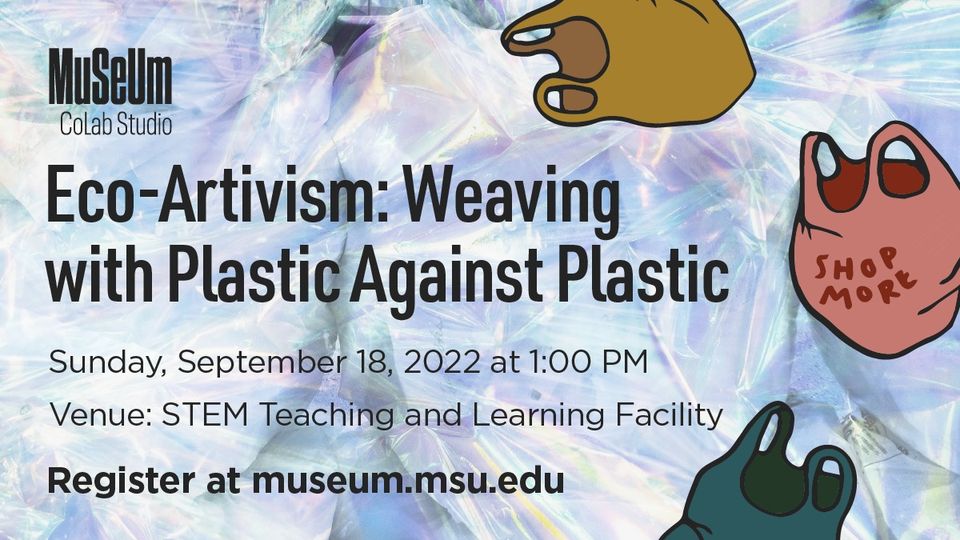
    Wagner will lead a weaving workshop on September 18 at the MSU Museum open to everyone in the community. Register at museum.msu.edu. Photo credit: MSU Museum. 

    Wagner’s undergrad training is in studio art and art history, and she found an interdisciplinary masters’ anthropology program where she was able to develop her art in relation to sustainability and the environment. 

    “I was passionate about and  wanted to get more involved with environmentalism, but I never saw myself as a  natural scientist,” she said. “But during my master’s, I started going to work at this elephant organization in Thailand, and it made me realize for the first time that conservation is really about people, and it’s about communities.”

    Once she graduated from her master’s program, she worked for a year in Cambodia for an environmental organization as their exhibitions coordinator for their natural history museum. She was applying to MSU at the time and getting in touch with Dr. Beth Drexler, who is now her current graduate advisor. 

    “She was excited about the idea of blending visual anthropology and interdisciplinary research, and environmental activism, which is so exciting, because it was important to me to find an advisor and a program that values interdisciplinary work and activism,” she said. “That’s really why I ended up at MSU in this program, because I felt like there’s so many people that were studying different things and blending different bodies of knowledge, especially in a four field program. And that felt like the right fit for me. It all fell into place that I would be able to use my background in arts, my love of elephants and the environment. And then just also being really interested in how people relate to environments.”

    Wagner is in her fourth year of her MSU Anthropology PhD program. In October, she will travel to Thailand to start her dissertation research. Her work focuses on human-environment and human-animal relationships, and how people have long-standing traditions of interacting with the environment, interacting with animals in the ecosystems in ways that are part of their culture. In Thailand, she is specifically interested in researching human-elephant relationships.

    “I have been obsessed with elephants since I was a little girl, so it’s been a life-long passion of mine,” Wagner smiled. “In Thailand, elephants are so common in material culture and pop culture. They’re the national cultural symbol, and everywhere you go, there are sculptures of elephants outside buildings, in restaurants, t-shirts, and tourism goods – you see elephants everywhere. I’m also an artist, so I like seeing how elephants are portrayed and what a particular culture or community within that culture thinks about these animals and how they treat them.”

    There’s a conservation component of her research where she’ll be continuing to work with the elephant organization Elephant Nature Park in Chiang Mai that she’s been working with since her master’s.

    “It’s a giant elephant sanctuary where they have over 100 rescued elephants that have been rescued from circuses, street begging, logging – many unethical, unfair labor situations. The sanctuary is run by a local Thai woman who only hires local Thai and nearby ethnic groups to work at this organization caring for the elephants. Then, tourists come in and pay to clean up after the elephants and feed them. It’s a huge organization that does a lot for local communities, including funding and building some local schools.”

    Wagner working with Elephant Nature Park in Chiang Mai, Thailand, where she will complete her dissertation research. Photo credit: Kelsey Merreck Wagner

    Through the organization, Wagner hopes to do a community engagement art project with the youth. While she envisions giant murals or a large art installation, she’s also leaving it open-ended because she wants the youth to express their ideas for the project.

    “I’m trying to really just make those connections between activism and expression, both personal expression and community expression by bringing in the idea of talking about the environment through art. Anthropologists are really interested in applied and activist anthropology, and pondering how our research can contribute to issues as broad as climate change and human rights. And so for me, that’s why it’s really important to be working on these different art projects and activism projects with community members, and especially youth, because I see it as my way to be able to like give back in this very specific art and activism skill set that I’ve been developing for more than 10 years now.” 

    View Wagner’s work and join in the discussion about climate change at the MSU Museum Science Gallery 1.5 ° Celsius exhibition: https://museum.msu.edu/?exhibition=1-5-celsius. The weaving workshop is on the MSU campus from 1:00-2:00 on Sunday, September 18. You can register here.

    To learn more about the MSU Department of Anthropology, visit anthropology.msu.edu

  • Dr. Barbara Rose Johnston, Adjunct Professor of Anthropology at Michigan State University, has been honored with a named award. At the annual American Anthropological Association (AAA) meeting this year the AAA Environment & Anthropology Society is launching the new award: Barbara Rose Johnston Travel Award.

    Barbara Rose Johnston Travel Award is a $1000 competitive grant to allow a society member at any stage in their career who lack institutional support to attend the AAA annual meeting and formally participate in Environment and Anthropology Society sessions. This competition is open to any member of the Society who lacks institutional support for conference travel, including those working for government agencies (federal, state, local, and tribal governments), nonprofits, community colleges, consultants, international scholars, and contingent faculty.

    Deadline to apply: October 3, 2022

    Full details can be found at:  https://ae.americananthro.org/prizes/barbara-rose-johnston-award/

  • Ph.D. Candidate Kiana Sakimehr wins the 2022 John F. Richards Fellowship offered by the American Institute of Afghanistan Studies (AIAS)

    The Department of Anthropology is pleased to announce that Ph.D. candidate Kiana Sakimehr has been awarded the John F. Richards Fellowship by the American Institute of Afghanistan Studies (AIAS). This institute is a private and non-profit organization located at Boston University and headed by scholars to promote and support the study of Afghanistan. 

    Kiana will use the funds to cover expenses related to her field research that focuses on Afghan refugees who recently arrived in the US. She intends to investigate the often-neglected emotional aspect of migration and how it shapes peoples’ interpretations and perceptions of their new reality as refugees. By focusing on the wide-ranging functions of emotions, her project examines the possible reconfiguration of and transitions in emotions with regards to expectations of living in the US. Moreover, her study explores the role of institutional structural possibilities and constraints regarding these transitions in emotions. Kiana acknowledges the support she has received from her committee members, specifically her advisor Dr. Chantal Tetreault.

  • Associate Professor Dr. Masako Fujita publishes in the American Journal of Biological Anthropology

    Department of Anthropology Associate Professor Dr. Masako Fujita and co-authors Katherine Wander, Tin Tran, and Eleanor Brindle recently published an article in the American Journal of Biological Anthropology. The article is titled “Characterizing the extent human milk folate is buffered against maternal malnutrition and infection in drought-stricken northern Kenya.” This publication investigates whether and how the extent of maternal buffering of milk folate may diminish under prolonged nutritional and disease stress, while taking into consideration infants’ varying vulnerability to malnutrition-related morbidity/mortality. The results of this study suggest that mothers buffer milk folate against their own nutritional stress even during a prolonged drought; however, the extent of this buffering may vary with infant age, and, among folate-deficient mothers, with infant sex.

    Read the full article at: https://doi.org/10.1002/ajpa.24603

    Abstract:

    Objectives: Folate is an essential nutrient fundamental to human growth and development. Human milk maintains high folate content across the maternal folate status range, suggesting buffering of milk folate with prioritized delivery to milk at the expense of maternal depletion. We investigated whether and how the extent of this buffering may diminish under prolonged nutritional and/or disease stress, while taking into consideration infants’ varying vulnerability to malnutrition-related morbidity/mortality.

    Methods: A cross-sectional study analyzed milk specimens from northern Kenyan mothers (n=203), surveyed during a historic drought and ensuing food shortage. Multiple regression models for folate receptor-α(FOLR1) in milk were constructed. Predictors included maternal underweight (BMI < 18.5), iron-deficiency anemia (hemoglobin <12 g/dl and dried-blood-spot transferrin receptor >5 mg/L), folate deficiency (hyperhomocysteinemia, homocysteine >12 or 14μmol/L), inflammation (serum C-reactive protein >5 mg/L), infant age and sex, and mother-infant interactions.

    Results: In adjusted models, milk FOLR1 was unassociated with maternal under-weight, iron-deficiency anemia and inflammation. FOLR1 was positively associated with maternal folate deficiency, and inversely associated with infant age. There was interaction between infant age and maternal underweight, and between infant sex and maternal folate deficiency, predicting complex changes in FOLR1.

    Conclusions: Our results suggest that mothers buffer milk folate against their own nutritional stress even during a prolonged drought; however, the extent of this buffering may vary with infant age, and, among folate-deficient mothers, with infant sex. Future research is needed to better understand this variability in maternal buffering of milk folate and how it relates to folate status in nursing infants.

  • Associate Professor Dr. Elizabeth Drexler publishes in Oxford University Press’ International Journal of Transitional Justice

    Department of Anthropology Associate Professor Dr. Elizabeth Drexler publishes in the International Journal of Transitional Justice. The article, titled, “Impunity and Transitional Justice in Indonesia: Aksi Kamisan’s Circular Time” argues the Indonesian weekly Thursday silent protests by victims’ families, create sites of justice bringing together technical legal demands with compelling artistic performance to highlight the problem of persistent but invisible impunity, counter the legacies of authoritarian era social stigmatization, and expose the problematic nature of temporality in conventional transitional justice mechanisms.    

    Read the full article at: https://doi.org/10.1093/ijtj/ijac010

    Abstract: This article positions the Indonesian weekly Thursday silent protests by victims’ families, Aksi Kamisan, as a space of and beyond transitional justice. Analysing Kamisan as repeated, embodied creative acts that reset perceptions, possibilities and imaginations about social belonging, political subjectivity and national identity discloses how authoritarian era affective forces undermine transitional justice and demonstrates the power of alternative temporalities in coming to terms with past violence. ‘Circular time’ brings past and present injustice into the same frame as consistent action extending into the future. Circular time highlights how the time of waiting, uncertainty and lack of justice extends backward and forward connecting past, present and future in the repetition of impunity, and creates community and the space to imagine just futures. Circular time is created by repeated action against impunity in the present and celebrating the perseverance, consistency and agency of victims. Circular time resists the imposition of temporal linearity. Art performed at Kamisan and the act of standing in solidarity engages communities and audiences in a realm of politics and national belonging that is not possible in formal institutions. Over time, these repeated, temporary, inclusive actions can counter still resonant authoritarian era propaganda.

  • Ph.D. Student Emily Milton and Assistant Professor Kurt Rademaker publish in the Journal of Archaeological Science

    Department of Anthropology Ph.D. student Emily Milton published her Master of Arts research in the Journal of Archaeological Science with co-authors Dr. Kurt Rademaker, Dr. Nathan D. Stansell (Northern Illinois University), Drs Hervé Bocherens and Döbereiner Chala-Aldana (University of Tübingen, Germany), and Annalis Brownlee (University of Alaska-Anchorage). The article, titled, “Examining surface water δ18O and δ2H values in the western Central Andes: A watershed moment for anthropological mobility studies,” reviews the isotopic patterning of surface waters in the western Peruvian Andes and implications for archaeological and forensic migration research. Emily’s research was funded by a National Science Foundation grant (PI: Dr. Rademaker) and the William A Lovis Research Fund in Environmental Archaeology.

    Read the full article at: https://doi.org/10.1016/j.jas.2022.105655

    Abstract: Oxygen isotopes are commonly applied to study archaeological human and animal mobility among the vertical ecological zones of the Central Andes in South America. Such research assumes that oxygen and hydrogen isotopes in meteoric waters demonstrate an inverse relationship with elevation. However, because the primary source of precipitation in the Central Andes is the Atlantic Ocean, this expectation is likely complicated by surface-level processes on the western Andean slope. We evaluate the spatial patterning of stable isotope values in surface waters along a coast-highland transect in southern Peru (∼15-17°S). Surface water δ18O and δ2H values in the study area are consistent with regional and global meteoric waters. However, lowland and highland surface waters demonstrate wide variability and overlapping ranges of surface water isotope values. Therefore, it is challenging to discern the origin of surface waters based on elevation alone. Rather, surface water δ18O and δ2H values appear to reflect hydrologic processes including seasonality, stream order, catchment size, and distance from the source. We identify the “Watershed Effect,” which precludes the use of δ18O and δ2H in Andean bioarchaeological studies of inter-zonal mobility. Moreover, changing hydroclimate over the Holocene and present sampling precision for biological analytes confound existing interpretations of δ18O derived from archaeological bioapatite. Given the regional complexities of δ18Owater presented here, isotopic assessments of human paleomobility require better baseline data than those currently available for the Central Andes. We contend that previous archaeological datasets using δ18Obioapatite to assess mobility between high and low elevations should be re-evaluated. Further, future studies should provide adequate baseline data to justify archaeological analyses and support subsequent interpretations.

  • Associate Professor Dr. Joe Hefner and Ph.D. Candidate Micayla Spiros co-publish in the University of Florida Press’ Forensic Anthropology Journal

    Department of Anthropology Associate Professor Dr. Joe Hefner and Ph.D. Candidate Micayla Spiros and co-authors Sherry Nakhaeizadeh, Tim J.U. Thompson, Ruth M. Morgan, Viktor Olsson, Alexandra Berivoe, and Martin Arvidsson published their work in the University of Florida Press’ Forensic Anthropology Journal. The article is titled “Using Eye-Tracking Technology to Quantify the Effect of Experience and Education on Forensic Anthropological Analyses.” The article discusses how the human interpretation of analytical outputs is a significant challenge in forensic science, making it vital to explore the application of protocols as we enhance our practices. This study assesses decision making in forensic anthropological analyses utilizing eye-tracking technology to quantify an observer’s estimate of confidence and reliability. The manuscript focuses on empirical decision-making studies, forensic anthropologists can improve practices—increasing the transparency of evaluative decision making by targeting confusing or problematic aspects of a data collection practice, and in so doing, enhance training. 

    Read the full article at: https://journals.upress.ufl.edu/fa/article/view/1934

    Abstract: “The human interpretation of analytical outputs is a significant challenge in forensic science, making it vital to explore the application of protocols as we enhance our practices. This study assesses decision making in forensic anthropological analyses utilizing eye-tracking technology to quantify an observer’s estimate of confidence and reliability. Ten individuals with varying levels of education and experience were asked to score cranial morphologies for two human crania. Each participant’s fixation points, fixation duration, and visit count and duration were assessed using Tobii™ Pro 2 eye-tracking glasses. Mid-facial morphologies capturing relative widths were the quickest scored traits, with an overall median time of 14.59 seconds; more complex morphological assessments took longer. Using time as a proxy for confidence, Kruskal-Wallis rank sum results indicate individuals with less experience differed significantly from individuals with greater experience (p = 0.01) although differences in level of education were not significant. Interestingly, intraclass correlation coefficients (ICC) indicate interobserver reliability is high between observers, suggesting experience only slightly improves agreement. These preliminary results suggest experience is more important than level of education. Through empirical decision making studies, forensic anthropologists can improve practices—increasing the transparency of evaluative decision making by targeting confusing or problematic aspects of a data collection practice, and in so doing, enhance training.”

  • Associate Professor Dr. Masako Fujita co-authors article in Evolution, Medicine, and Public Health

    Department of Anthropology Associate Professor Dr. Masako Fujita and co-authors Katherine Wander, Siobhan Mattison, Blandina Mmbaga and others publish in Evolution, Medicine, and Public Health.  

    The article is titled “Tradeoffs in milk immunity affect infant infectious disease risk.” The article discusses research on milk immune activity, a new area of research, among almost 100 breastfeeding mother–infant dyads in Kilimanjaro, Tanzania.

    The study used a new lab-based technique and described how mothers’ milk differed in their immune responses to some bacteria, and followed the infants to see whether those receiving milk with stronger responses in lab were less likely to develop infectious diseases.  

    They found support for this with the infectious agent Salmonella. Infants receiving milk with stronger pro-inflammatory responses to Salmonella had lower risk for respiratory infections during the 2.5 months follow-up period. However, they also found the opposite pattern with a non-infectious bacterium. Infants receiving milk that responded strongly to the benign strains of E. coli (that tends to exist harmoniously in our digestive systems) had higher risk for gastrointestinal infections. Moreover, milk responses to Salmonella tended to co-occur with responses to E.coli, suggesting that milk with strong immune responses have potential to decrease risk for some infections but increase others among infants.  

    Their findings make sense in that immune protections often come with collateral damage because the immune system does not always differentiate pathogenic from benign targets, giving rise to allergies and auto-immune conditions, for example. Still, the study’s discovery of protective and harmful effects of milk immune activity on infant infectious disease risk comes as a bit of surprise because we tend to think of milk as the mighty fluid that does no harm. The reality seems a bit more complicated, calling for future research to clarify how the immune system of milk has evolved to strike a balance between protection and harm.

    News coverage about the article: https://medicalxpress.com/news/2022-07-boost-breastfeeding-immune-benefits.html

    Read the article here: https://doi.org/10.1093/emph/eoac020

    Abstract:

    “Background and objectives

    The human immune system has evolved to balance protection against infection with control of immune-mediated damage and tolerance of commensal microbes. Such tradeoffs between protection and harm almost certainly extend to the immune system of milk.

    Methodology

    Among breastfeeding mother–infant dyads in Kilimanjaro, Tanzania, we characterized in vitro proinflammatory milk immune responses to Salmonella enterica (an infectious agent) and Escherichia coli (a benign target) as the increase in interleukin-6 after 24 h of incubation with each bacterium. We characterized incident infectious diseases among infants through passive monitoring. We used Cox proportional hazards models to describe associations between milk immune activity and infant infectious disease.

    Results

    Among infants, risk for respiratory infections declined with increasing milk in vitro proinflammatory response to S. enterica (hazard ratio [HR]: 0.68; 95% confidence interval [CI]: 0.54, 0.86; P: 0.001), while risk for gastrointestinal infections increased with increasing milk in vitro proinflammatory response to E. coli (HR: 1.44; 95% CI: 1.05, 1.99; P: 0.022). Milk proinflammatory responses to S. enterica and E. coli were positively correlated (Spearman’s rho: 0.60; P: 0.000).

    Conclusions and implications

    These findings demonstrate a tradeoff in milk immune activity: the benefits of appropriate proinflammatory activity come at the hazard of misdirected proinflammatory activity. This tradeoff is likely to affect infant health in complex ways, depending on prevailing infectious disease conditions. How mother–infant dyads optimize proinflammatory milk immune activity should be a central question in future ecological–evolutionary studies of the immune system of milk.”


  • Featured Faculty, Dr. Mindy Morgan

    Featured Faculty, Dr. Mindy Morgan

    Dr. Mindy Morgan is an Associate Professor of Anthropology and affiliated faculty member of the American Indian and Indigenous Studies program, as well as the Graduate Program Director for the Department of Anthropology. Dr. Morgan specializes in sociocultural and linguistic anthropology.

    Dr. Ruth Underhill fieldwork
    Dr. Ruth Underhill, center (image provided by the Denver Museum of Nature & Science)

    Over the course of the past few years, Dr. Morgan has been exploring the history of anthropology and engaging in new conversations regarding our disciplinary past. This work grew from her larger investigation into the periodical Indians at Work, which was published by the Office of Indian Affairs in the 1930s and contained articles authored by bureaucrats, tribal members, and anthropologists. Dr. Ruth M. Underhill, an anthropologist trained by Franz Boas at Columbia University, was one of these contributors. Dr. Morgan first wrote about Underhill’s contributions to anthropological debates at the time in her 2017 article Anthropologists in Unexpected Places: Tracing Anthropological Theory, Practice, and Policy in Indians at Work, which was published in the American Anthropologist. During this time, Dr. Morgan also helped coordinate a roundtable for the American Anthropological Association meetings in Minneapolis that allowed her to think more deeply about the ways in which Underhill participated in both the production and circulation of disciplinary knowledge in the early 20th century.

    Singing For Power, Ruth Underhill

    Dr. Morgan’s recent 2019 article, “Look Once More at the Old Things”: Ruth Underhill’s O’odham Text Collections which appears in Histories of Anthropology Annual, vol. 13, grew out of the paper for the roundtable. In the article, she looks at the ways in which Underhill’s collection of O’odham songs and texts in the early 20th century was taken up by others decades later, and reinterpreted according to the needs of the contemporary community. Many of the songs collected by Underhill for her seminal work Singing for Power were retranslated and republished in the 1970s by O’odham community members, Baptisto Lopez, José Pancho, and David Lopez working in collaboration with the anthropologist, Donald Bahr. Their work, Rainhouse and Ocean: Speeches for the Papago Year, does not just reproduce Underhill’s text but extends them by offering new insights and analyses of the songs. A later edition of Singing for Power was issued that carried an introduction by Ofelia Zepeda, an O’odham linguist and scholar working within the language revitalization movement of the early 1990s. Dr. Morgan looks at how these various entextualizations not only bring new meanings, but new opportunities for transmission and circulation. A central argument in the article is that Underhill’s manner of both collecting and representing the song texts was prescient and indicated her own belief that these texts would and should continue to circulate among the O’odham community for generations to come.

  • Assistant Professor Dr. Lucero Radonic, Ph.D. Candidate Cara Jacob, alumna Dr. Rowen Kalman, and community partner Yvonne Lewis co-publish in Case Studies in the Environment

    Department of Anthropology Assistant Professor Dr. Lucero Radonic, Ph.D. Candidate Cara Jacob, alumna Dr. Rowen Kalman, and community partner Yvonne Lewis co-publish in Case Studies in the Environment. The article is titled “Questionable Quality: Using Photovoice to Document Women’s Experiences of Water Insecurity in Flint, USA.” The article discusses a Flint, Michigan based community-based participatory research project documenting grassroots narratives about the impacts of water insecurity on the lives of women. 

    Read the full article at: https://doi.org/10.1525/cse.2022.1706476

    Abstract: “Household water insecurity is a global problem; one not escaped by residents of high-income nations. In this article, we review a community-based participatory research (CBPR) project conducted in Flint, MI, to document grassroots narratives about the impacts of water insecurity on the lives of women. In 2014, Flint residents found themselves connected to modern water infrastructure that delivered potable water contaminated by lead and pathogens. Through a photovoice method, participating women documented how experiences of water insecurity continues to impact their lives many years after state authorities declared the water crisis to be over. This study adds to a growing literature that highlights how the “adequateness” of water quality is not a stable or self-evident condition for there are different frameworks for water cleanliness, safety, and risk. With attention to methodology, this case study emphasizes the importance of legitimizing the embodied experience of participants through research design and implementation. This CBPR project contributes to the existing toolbox of methods for studying household water insecurity by complementing the growing literature on security metrics with a narrative-focused approach to documenting women’s lived experiences of water insecurity. Finally, the article invites readers to consider how and to what degree to mobilize participatory approaches to understand conditions and lived experiences of resource insecurity without further stigmatizing or exploiting impacted communities.”